I really like this subject because i think it is really interesting to see how other cultures are regarding(behavior,customs,economy,politics,etc...)and how all of these affects the organizations in that particular culture,because i think that we as international business students need to be aware of the different treatment each different culture needs according to their own history.
Working with blogs was really nice because i haven't worked with any blog before,and when i got to visit BOB's website and my classmates blogs i got to see how different we can be , i like the topic i chosed for my academic research and i think it was very useful to see how is the gay subculture's work in Colombia affected by their sexual condition. Regarding the presentations i like the different topics ,but i didn't like the fact that they were so long ,the class is 3 hours ,from which 0ne and a half was the presentation ,15 minutes break and then the techer explained certain things.I think the time of the presentation shoul be reduced.
i like the fact that the class was dynamic ,we saw movies, and made several interesting activities.
I really liked this course!
sábado, 22 de mayo de 2010

LATIN AMERICA
THE UNION OF SOUTH AMERICAN NATIONS (UNASUR)

Is an intergovernmental union that integrates two existing customs unions as part of a continuing process of South American integration: Mercosur and the Andean Community of nations. It is based on the European union. Its Constitutive Treaty was signed on May 23, 2008; the Union's headquarters are located in Quito, Ecuador. The group has the intention to model the community after the European Union this includes a common currency, a parliament, and a passport, according to studies a complete union like that of the EU should be possible by 2019.One important characteristic in order to prevent bureaucracy is that no new institutions will be created in the first phase
The main ideas of UNASUR ARE:
A) Creation of a single market, with the elimination of tariffs for non-sensitive products by 2014, and for sensitive products by 2019.
b) Economic development through the South American Bank launched by presidents of: Argentina, Bolivia, Brazil, Ecuador, Paraguay, Venezuela and Uruguay, this bank will finance economic development projects to improve local competitiveness and promote the scientific and technological development of the member states.
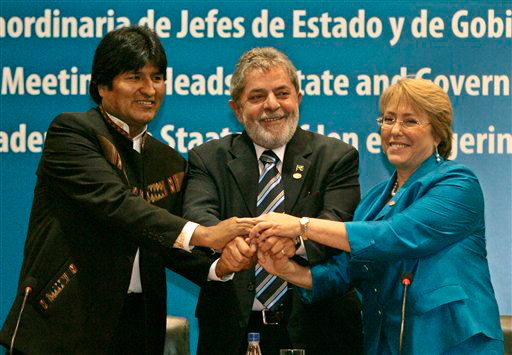
c) Regarding the Defense policy, The South American Defense Council (SADC) (proposed by Venezuela and Brazil) to serve as a NATO-like mechanism for regional security, promoting military co-operation and regional defense.
d) Plans of integration through infrastructure cooperation with the construction of the Interoceanic Highway, (road that pretends to link the Pacific Coast countries, especially Chile and Peru with Brazil and Argentina by the construction of extending highways through the continent, making easier the connections to ports .The construction of the first corridor first between Peru and Brazil, began in September 2005.
e) The idea of Free movement of people which states that visits by any South American citizen to any South American country of up to 90 days only require an identity card issued by the respective authority of the travelers’ country of origin.
Bibliography:
Union of South American Nations. (n.d.). In Wikipedia. Retrieved May 20,2010, from http://en.wikipedia.org/wiki/Union_of_South_American_Nations
Is an intergovernmental union that integrates two existing customs unions as part of a continuing process of South American integration: Mercosur and the Andean Community of nations. It is based on the European union. Its Constitutive Treaty was signed on May 23, 2008; the Union's headquarters are located in Quito, Ecuador. The group has the intention to model the community after the European Union this includes a common currency, a parliament, and a passport, according to studies a complete union like that of the EU should be possible by 2019.One important characteristic in order to prevent bureaucracy is that no new institutions will be created in the first phase
The main ideas of UNASUR ARE:
A) Creation of a single market, with the elimination of tariffs for non-sensitive products by 2014, and for sensitive products by 2019.
b) Economic development through the South American Bank launched by presidents of: Argentina, Bolivia, Brazil, Ecuador, Paraguay, Venezuela and Uruguay, this bank will finance economic development projects to improve local competitiveness and promote the scientific and technological development of the member states.
c) Regarding the Defense policy, The South American Defense Council (SADC) (proposed by Venezuela and Brazil) to serve as a NATO-like mechanism for regional security, promoting military co-operation and regional defense.
d) Plans of integration through infrastructure cooperation with the construction of the Interoceanic Highway, (road that pretends to link the Pacific Coast countries, especially Chile and Peru with Brazil and Argentina by the construction of extending highways through the continent, making easier the connections to ports .The construction of the first corridor first between Peru and Brazil, began in September 2005.
e) The idea of Free movement of people which states that visits by any South American citizen to any South American country of up to 90 days only require an identity card issued by the respective authority of the travelers’ country of origin.
Bibliography:
Union of South American Nations. (n.d.). In Wikipedia. Retrieved May 20,2010, from http://en.wikipedia.org/wiki/Union_of_South_American_Nations
AUSTRALIA
THE STOLEN GENERATIONS:
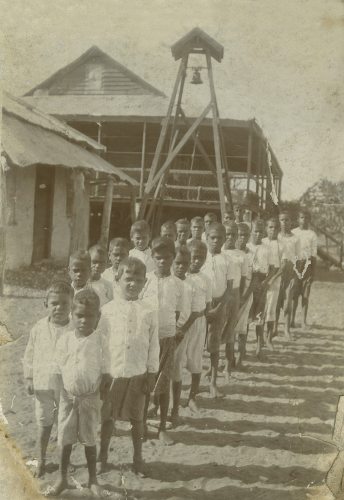
First of all The Stolen Generations refers to those children who were removed from their families by the Australian government agencies and church missioners, under several acts of their respective parliaments. On February 13 2008, Australia’s Prime Minister Kevin Rudd presented the apology to Indigenous Australians:
"Today we honor the Indigenous peoples of this land, the oldest continuing cultures in human history. We reflect on their past mistreatment. We reflect in particular on the mistreatment of those who were Stolen Generations - this blemished chapter in our nation's history. The time has now come for the nation to turn a new page in Australia's history by righting the wrongs of the past and so moving forward with confidence to the future. We apologize for the laws and policies of successive Parliaments and governments that have inflicted profound grief, suffering and loss on these our fellow Australians. We apologize especially for the removal of Aboriginal and Torres Strait Islander children from their families, their communities and their country................................. We today take this first step by acknowledging the past and laying claim to a future that embraces all Australians. A future where this Parliament resolves that the injustices of the past must never, never happen again. A future where we harness the determination of all Australians, Indigenous and non-Indigenous, to close the gap that lies between us in life expectancy, educational achievement and economic opportunity......A future based on mutual respect, mutual resolve and mutual responsibility. A future where all Australians, whatever their origins, are truly equal partners, with equal opportunities and with an equal stake in shaping the next chapter in the history of this great country, Australia"
FROM YOU OWN POINT OF VIEW IS IT USEFUL TO SAY "SORRY" AFTER YEARS OF WRONG POLICIES TOWARDS A MINORITY?WHY? WHAT ELSE IS NEEDED?

To say sorry is one of the hardest thing to say, because If you say you are sorry for something, you are implicitly taking responsibility for whatever has happened, so I think it is useful to say sorry when things are not done in the right way by a government or by anyone else, because an excuse at least means that you recognized you acted wrong, but an excuse is not the only thing to emend a mistake, because for example ,in this case, how useful is to a minority that that the government say he is sorry when he is not really feeling it?, when he doesn’t really regret his acts? or when he is going to do the same thing afterwards keeping the wrong policies?,i think people have to say sorry when they really mean this word and when they are willing to do something to emend their mistakes and make things change, in this case a correction on the wrong policies is also needed, the government needs to recognize that we are all equals ,and treat them as equals, do not violate their rights and ensure they are protected ,not the other way. Just as Kevin Rutt said on the speech governments have to learn from their past bad experiences and look at the future with hope and determination to change, they have to work in order to not commit the same mistakes and injusticies, they have to look for a future with opportunities for everyone, a future with new solutions to the problems of the past.
First of all The Stolen Generations refers to those children who were removed from their families by the Australian government agencies and church missioners, under several acts of their respective parliaments. On February 13 2008, Australia’s Prime Minister Kevin Rudd presented the apology to Indigenous Australians:
"Today we honor the Indigenous peoples of this land, the oldest continuing cultures in human history. We reflect on their past mistreatment. We reflect in particular on the mistreatment of those who were Stolen Generations - this blemished chapter in our nation's history. The time has now come for the nation to turn a new page in Australia's history by righting the wrongs of the past and so moving forward with confidence to the future. We apologize for the laws and policies of successive Parliaments and governments that have inflicted profound grief, suffering and loss on these our fellow Australians. We apologize especially for the removal of Aboriginal and Torres Strait Islander children from their families, their communities and their country................................. We today take this first step by acknowledging the past and laying claim to a future that embraces all Australians. A future where this Parliament resolves that the injustices of the past must never, never happen again. A future where we harness the determination of all Australians, Indigenous and non-Indigenous, to close the gap that lies between us in life expectancy, educational achievement and economic opportunity......A future based on mutual respect, mutual resolve and mutual responsibility. A future where all Australians, whatever their origins, are truly equal partners, with equal opportunities and with an equal stake in shaping the next chapter in the history of this great country, Australia"
FROM YOU OWN POINT OF VIEW IS IT USEFUL TO SAY "SORRY" AFTER YEARS OF WRONG POLICIES TOWARDS A MINORITY?WHY? WHAT ELSE IS NEEDED?
To say sorry is one of the hardest thing to say, because If you say you are sorry for something, you are implicitly taking responsibility for whatever has happened, so I think it is useful to say sorry when things are not done in the right way by a government or by anyone else, because an excuse at least means that you recognized you acted wrong, but an excuse is not the only thing to emend a mistake, because for example ,in this case, how useful is to a minority that that the government say he is sorry when he is not really feeling it?, when he doesn’t really regret his acts? or when he is going to do the same thing afterwards keeping the wrong policies?,i think people have to say sorry when they really mean this word and when they are willing to do something to emend their mistakes and make things change, in this case a correction on the wrong policies is also needed, the government needs to recognize that we are all equals ,and treat them as equals, do not violate their rights and ensure they are protected ,not the other way. Just as Kevin Rutt said on the speech governments have to learn from their past bad experiences and look at the future with hope and determination to change, they have to work in order to not commit the same mistakes and injusticies, they have to look for a future with opportunities for everyone, a future with new solutions to the problems of the past.
miércoles, 12 de mayo de 2010
THE FIVE BLOGS FROM MY CLASS
The 5 blogs from the class I visited are:
-http://www.marianap123.blogspot.com/
I think there are a lot of activities missing in this blog, she only has until the average sales person in Colombia, she is missing the first and second blog review we had to do to the blogs of our classmates and to choose which was the best one, she is also missing the topics we have already covered such as the middle east banking system or the e commerce,Australia,the visit to bobs website and the writing about trade union in Colombia and in Europe, I also think she should make her blog more attractive to the view by putting some pictures ,videos or interesting articles.
-http://melicoulson.blogspot.com/2010/05/europe-and-colombia.html
I think this is a good blog, it has pictures and links to videos, it is organized and attractive to the view, but she is missing the middle east ,Australia and the review of our class blogs activities regarding European trade unions writing ,I like how she introduced the European union and the definition of a trade union, because since the European union is a mixture of different countries, with different customs ,culture ,languages among other things, trade unions in each country are different, and in Colombia since we are talking about just one country with similar people, language and customs things change, so the comparison won’t be always fair.
-http://paulalopezrestrepo.blogspot.com/
Regarding this blog I like the way she justify her answer to the e question of the corporation movie, even thought I don’t agree with her, because I think the root cause of the problem are not only corporations, but capitalism and consumism too, I like how she linked the phrase “the end justifies the means” with the actual problem. I like how she use the Hofstede's analysis to explain the situation of a sales person in Colombia, and the fact that she did an extra activity on the blog which was to write about management style in Colombia and a comparison between this style and the Korean style, but I think that for the date she is missing lots of activities:-Middle East-Australia-European and Colombian trade unions writing-the review about BOB's website blogs and about our classmates blogs, I think she should put some pictures and videos in the blog.
-http://natashacardona.blogspot.com/
I think this is a good blog, I like the introduction she gave to the blog with the phrase:”big thinking proceeds great achievement”, I completely agree with the other phrase too:”To look out with a broader, bigger, and more accurate perspective are the goals that every business man should try to reach in order to create a successfully future, understanding and respecting diversity acknowledging that we are living in a world where people are becoming more and more closely interconnected.”, because I think that in the global world we are living in is important to have a global perspective, an open mind, to understand we live in an interconnected world ,and that we are all different and t6ht we can use those differences to create advantages for the future. The blog has pictures and an interesting video about an apology of Kevin Rutt regarding Australia’s situation towards minorities discrimination, as she said: Kevin Rudd offered a broad apology to all aborigines and the Stolen Generations for their "profound grief, suffering and loss" in a carefully worded statement that was greeted by a standing ovation.
But I think the blog is also missing the Middle East banking system or e commerce writing, the European and Colombian trade unions writing, and the reviews to bobs website blogs and to the blogs of our classmates
BUT MY FAVORITE BLOG FROM THE FIVE IS:

-http://www.carlosvallejod34.blogspot.com/
Because he has the blog updated with all the activities we had to do, he is organized and I like the way he exposed his ideas, they are clear, and the way he justifies his opinions with great arguments, he also has images, charts and a well referenced bibliography. I want to say that I really like his article about the stolen generation on which he justifies that the remedy has been worse than the mistake, exposing certain points for this argument.
I think it is an excellent blog!
-http://www.marianap123.blogspot.com/
I think there are a lot of activities missing in this blog, she only has until the average sales person in Colombia, she is missing the first and second blog review we had to do to the blogs of our classmates and to choose which was the best one, she is also missing the topics we have already covered such as the middle east banking system or the e commerce,Australia,the visit to bobs website and the writing about trade union in Colombia and in Europe, I also think she should make her blog more attractive to the view by putting some pictures ,videos or interesting articles.
-http://melicoulson.blogspot.com/2010/05/europe-and-colombia.html
I think this is a good blog, it has pictures and links to videos, it is organized and attractive to the view, but she is missing the middle east ,Australia and the review of our class blogs activities regarding European trade unions writing ,I like how she introduced the European union and the definition of a trade union, because since the European union is a mixture of different countries, with different customs ,culture ,languages among other things, trade unions in each country are different, and in Colombia since we are talking about just one country with similar people, language and customs things change, so the comparison won’t be always fair.
-http://paulalopezrestrepo.blogspot.com/
Regarding this blog I like the way she justify her answer to the e question of the corporation movie, even thought I don’t agree with her, because I think the root cause of the problem are not only corporations, but capitalism and consumism too, I like how she linked the phrase “the end justifies the means” with the actual problem. I like how she use the Hofstede's analysis to explain the situation of a sales person in Colombia, and the fact that she did an extra activity on the blog which was to write about management style in Colombia and a comparison between this style and the Korean style, but I think that for the date she is missing lots of activities:-Middle East-Australia-European and Colombian trade unions writing-the review about BOB's website blogs and about our classmates blogs, I think she should put some pictures and videos in the blog.
-http://natashacardona.blogspot.com/
I think this is a good blog, I like the introduction she gave to the blog with the phrase:”big thinking proceeds great achievement”, I completely agree with the other phrase too:”To look out with a broader, bigger, and more accurate perspective are the goals that every business man should try to reach in order to create a successfully future, understanding and respecting diversity acknowledging that we are living in a world where people are becoming more and more closely interconnected.”, because I think that in the global world we are living in is important to have a global perspective, an open mind, to understand we live in an interconnected world ,and that we are all different and t6ht we can use those differences to create advantages for the future. The blog has pictures and an interesting video about an apology of Kevin Rutt regarding Australia’s situation towards minorities discrimination, as she said: Kevin Rudd offered a broad apology to all aborigines and the Stolen Generations for their "profound grief, suffering and loss" in a carefully worded statement that was greeted by a standing ovation.
But I think the blog is also missing the Middle East banking system or e commerce writing, the European and Colombian trade unions writing, and the reviews to bobs website blogs and to the blogs of our classmates
BUT MY FAVORITE BLOG FROM THE FIVE IS:
-http://www.carlosvallejod34.blogspot.com/
Because he has the blog updated with all the activities we had to do, he is organized and I like the way he exposed his ideas, they are clear, and the way he justifies his opinions with great arguments, he also has images, charts and a well referenced bibliography. I want to say that I really like his article about the stolen generation on which he justifies that the remedy has been worse than the mistake, exposing certain points for this argument.
I think it is an excellent blog!
TRADE UNIONS IN COLOMBIA AND TRADE UNIONS IN EUROPE
WHAT IS A TRADE UNION?
A trade unions is an organization of workers who joined together to achieve through its leadership common goals specially better working conditions, the union negotiates with the employer on behalf of union members certain specific aspects of the job contract ,aspects such as wages, work rules, complains, rules of the hiring, firing and promotion procedures, benefits, workplace safety and policies.

TRADE UNIONS IN EUROPE
Trade unions originated in Europe, and became popular in many European countries during the Industrial Revolution, when the increase in production and the lack of worker skills necessary to perform well in most jobs leave the employment negotiation power almost completely to the employers' side, this caused mistreatment and underpayment of many One important thing is that trade unions in Europe ,Colombia and almost all around the world , have all the same main purpose which is ” maintaining or improving the conditions of their employment “of course this purpose varies somehow depending on the working environment ,on the legal conditions,on the economic situation of the country we are talking about. Trade unions in Europe reached an enormous development with the performance of activities such as:
-The Provision of benefits to insure members against unemployment, ill health, old age and funeral expenses
-Collective bargaining: they are recognized by employers, and are able to negotiate with them over wages and working conditions.
-Industrial action: they may enforce strikes or resistance to lockouts in order to reach some particular goals.
-Political activity: Trade unions try to promote legislation of laws favorable to the interests of their workers as a whole, by doing campaigns, undertaking lobbying, or by giving financial support to individual candidates for public office.
but over the years there has been a decline in trade unions throughout Europe, Since the fall of the Iron Curtain in 1989, unionization has collapsed, In only 8 out of the current 27 member states of the EU are more than half of the employed population members of a trade union, The average level of union membership across the whole of the European Union, weighted by the numbers employed in the different member states is 24%. The EU's 4 most populated states all have low levels of unionization (Italy 30%, UK 29%, Germany 27% and France only 9%).in Europe 3 out of every 4 people employed are now not members of a trade union. Furthermore, in every EU country outside Scandinavia (except Belgium), trade union membership is either static or in decline. There is an estimation that the average level of unionization across the EU will fall be just fewer than 20% by 2010, but union membership is not the only indicator of the strength of the organization. In countries like Spain, for example, support for the unions is shown by the large number of votes they receive in works council elections, and in France, the unions have shown that despite low levels of membership they are able to mobilise workers in mass strikes and demonstrations of great effect. By another side Denmark, Sweden and Finland are at the top with around 70% of all employees in unions, mainly because unemployment and other social benefits are normally paid out through the union, although recent changes in the Swedish system of unemployment benefit have had a negative impact on union membership. This high union density in the Nordic countries reflects that the union membership is seen as a natural part of employment. But in central and eastern European countries the situation regarding unions is quite different, the climate is hostile toward unions they have below average levels of union membership. Seven of the 10 states in this position have union density levels below the EU average, including the largest, Poland, where 16% of employees are estimated to be union members, and this is not the only worrying thing, what is more worrying is that there are not perspectives of growth for the future, the situation of the labour unions is static, there hasn’t been a strong gain in union members among the employed in recent years, in general in most countries of the EU overall union membership has fallen. The losses are clearest in the states in Central and Eastern Europe, where industrial restructuring and a fundamental change in the role of unions has had a major impact. But there have also been major membership declines in the countries of Western Europe. In Germany, for example, the main union confederation, the DGB, has lost 47% of its membership since its peak in 1991, although the greatest losses were in the former East Germany. One important thing regarding unions belonging is that they grow when the employee belongs to the public sector, for example in the UK union figures are better because there has been a growth in employment in the public sector, where unions are stronger, the same thing happened in Poland, a survey found that union membership was highest at 25% in education, science and health, which are activities of the public sector, and in Sweden, a study undertaken for the largest union confederation LO found that the public sector had the highest level of union membership (between 88% and 90% depending on the type of work )–,while the lowest level was in private services (between 63% and 66%)
But even thought unions in Europe are tending to decrease, those that exist have a good practice of their labor and try to do their best helping their members by:
• Support in undertaking needs analysis and in the development of the career
• Direct help in finding new and better employment and in training and lifelong learning
• Support for staff who is working abroad
• Innovative uses of new technology in communicating with professional and managerial staff
European workers want their contribution at work to be better recognized, they want opportunities to improve their professional skills and qualifications and progress in their careers, they want a more professional but personal approach towards the employer tend the right to participate fully in strategic management decisions affecting their areas of responsibility.
European employment initiatives, have been characterized by the importance of lifelong learning, the actual percentage of European workers obtaining training is really low. One problem for this, is that management thinking continues to view vocational training (for professionals and managerial staff )–as cost, not as an investment, but European Unions contribute in several different ways to the increase in the training processes for members.firstly,for many unions it is a very important issue to set on the bargaining process, just like The Belgian managerial and professional union LBC-NVK said: “Training and retraining are such fundamental rights that we try at all costs to establish these rights in collective agreements, both at company and sector level” . There are several unions that run seminars and courses for managers and employees. A Scandinavian union said: “We help such members to create networks and develop their skills in subjects that are important to them”.
TRADE UNIONS IN COLOMBIA

Trade unions in Colombia ,like in Europe are tending to decrese,but not in the same amount as they are decreasing in the European continent ,maybe because European employers are characterized for being very good employers and try to do their best in order for the employees to feel like at home and perform well at work, the situation in Colombia sometimes is different, there are employees that are not happy with the salary, the subsidies, or the way they are working ,so they form trade unions, in order for workers to pursue their dreams, their aims, to be heard, sometimes strikes and revolts made by unions in Colombia have worked so well that have influenced some government policies.
Another important difference is that trade unions in Colombia are really influenced by the roman catholic church and the catholic religion, so they guide themselves by the catholic church principles, which is different than Europe, a continent with a mixture of religions and a continent where religion doesn’t play the important role it plays in Latin America, so it is common that trade unions are not influenced at all by religious principles.
Many of us think that trade unions in Colombia have been characterized for violence strikes and revolts ,but things have not been like that, the Colombian labor movement ,for example doesn’t have a long history of militant confrontation. This movement has been moderate, fragmented, and closely allied with the traditional parties or the Roman Catholic Church, but it has never accounted for more than one-third of the organized labor force, which itself represented only about 1/5 of the total labor force. In 1988 only 12 % of Colombia's economically active population was unionized. In the decade of the 1980s Situations like an increasing inflation, government corruption, and high unemployment increased labor militancy, but the labor legislation developed so much that it permitted the government a great amount of control over the labor movement. Legislation in Colombia gave priority to company-level unions by requiring them to negotiate at the company level, rather than at the industry level

One of the most important trade unions in our country is Unión de Trabajadores Colombianos,a central trade union confederation founded by the Jesuit elements of the Roman Catholic Church , based on Catholic social doctrine. Both industrialists and the Conservative government supported the UTC, mainly because it did not represent a threat to the political and economic elite.
The situation of trade unionists in Colombia has been hard. In the recent years hundreds of trade union activists have been murdered for the simple fact of belonging to a trade union and being involved on its activities. But one very good aspect regarding trade unions in Colombia is that to fight against violence and reach their goals many unions have received support from trade unions all around the world ,unions such as LO (Norway); UNISON (UK); SEIU (USA); IMPACT (Ireland); CAW (Canada); CEP (Canada); Amnesty International (UK); UNI (International); Garden Court barristers’ chambers (UK); Matrix barristers’ chambers (UK);and IMF metalworkers (International) among others.
Francisco maltes Tello (2010, April 27). Continua la lucha por la estabilidad laboral de los empleados públicos. Retrieved APRIL 30, 2010, from CUT website:http://www.cut.org.co/index.php?option=com_content&view=article&id=92:continua-la-lucha-por-la-estabilidad-laboral-de-los-empleados-publicos&catid=47:departamento-de-comunicaciones-publicidad-y-propaganda&Itemid=55
L. Fulton (2009) Worker representation in Europe. Labour Research Department and ETUI (online publication).retrieved may 9, 2010 from worker-participation website: http://www.worker-participation.eu/National-Industrial-Relations/Across-Europe/Trade-Unions2
Trade unions in Colombia. (n.d.). In Wikipedia. Retrieved May 1,
2010, from http://en.wikipedia.org/wiki/Special:Search/Trade_unions_in_Colombia
Trade unions in Europe. (n.d.). In Wikipedia. Retrieved May 1,
2010, from http://en.wikipedia.org/wiki/Trade_union#Europe
A trade unions is an organization of workers who joined together to achieve through its leadership common goals specially better working conditions, the union negotiates with the employer on behalf of union members certain specific aspects of the job contract ,aspects such as wages, work rules, complains, rules of the hiring, firing and promotion procedures, benefits, workplace safety and policies.
TRADE UNIONS IN EUROPE
Trade unions originated in Europe, and became popular in many European countries during the Industrial Revolution, when the increase in production and the lack of worker skills necessary to perform well in most jobs leave the employment negotiation power almost completely to the employers' side, this caused mistreatment and underpayment of many One important thing is that trade unions in Europe ,Colombia and almost all around the world , have all the same main purpose which is ” maintaining or improving the conditions of their employment “of course this purpose varies somehow depending on the working environment ,on the legal conditions,on the economic situation of the country we are talking about. Trade unions in Europe reached an enormous development with the performance of activities such as:
-The Provision of benefits to insure members against unemployment, ill health, old age and funeral expenses
-Collective bargaining: they are recognized by employers, and are able to negotiate with them over wages and working conditions.
-Industrial action: they may enforce strikes or resistance to lockouts in order to reach some particular goals.
-Political activity: Trade unions try to promote legislation of laws favorable to the interests of their workers as a whole, by doing campaigns, undertaking lobbying, or by giving financial support to individual candidates for public office.
but over the years there has been a decline in trade unions throughout Europe, Since the fall of the Iron Curtain in 1989, unionization has collapsed, In only 8 out of the current 27 member states of the EU are more than half of the employed population members of a trade union, The average level of union membership across the whole of the European Union, weighted by the numbers employed in the different member states is 24%. The EU's 4 most populated states all have low levels of unionization (Italy 30%, UK 29%, Germany 27% and France only 9%).in Europe 3 out of every 4 people employed are now not members of a trade union. Furthermore, in every EU country outside Scandinavia (except Belgium), trade union membership is either static or in decline. There is an estimation that the average level of unionization across the EU will fall be just fewer than 20% by 2010, but union membership is not the only indicator of the strength of the organization. In countries like Spain, for example, support for the unions is shown by the large number of votes they receive in works council elections, and in France, the unions have shown that despite low levels of membership they are able to mobilise workers in mass strikes and demonstrations of great effect. By another side Denmark, Sweden and Finland are at the top with around 70% of all employees in unions, mainly because unemployment and other social benefits are normally paid out through the union, although recent changes in the Swedish system of unemployment benefit have had a negative impact on union membership. This high union density in the Nordic countries reflects that the union membership is seen as a natural part of employment. But in central and eastern European countries the situation regarding unions is quite different, the climate is hostile toward unions they have below average levels of union membership. Seven of the 10 states in this position have union density levels below the EU average, including the largest, Poland, where 16% of employees are estimated to be union members, and this is not the only worrying thing, what is more worrying is that there are not perspectives of growth for the future, the situation of the labour unions is static, there hasn’t been a strong gain in union members among the employed in recent years, in general in most countries of the EU overall union membership has fallen. The losses are clearest in the states in Central and Eastern Europe, where industrial restructuring and a fundamental change in the role of unions has had a major impact. But there have also been major membership declines in the countries of Western Europe. In Germany, for example, the main union confederation, the DGB, has lost 47% of its membership since its peak in 1991, although the greatest losses were in the former East Germany. One important thing regarding unions belonging is that they grow when the employee belongs to the public sector, for example in the UK union figures are better because there has been a growth in employment in the public sector, where unions are stronger, the same thing happened in Poland, a survey found that union membership was highest at 25% in education, science and health, which are activities of the public sector, and in Sweden, a study undertaken for the largest union confederation LO found that the public sector had the highest level of union membership (between 88% and 90% depending on the type of work )–,while the lowest level was in private services (between 63% and 66%)
But even thought unions in Europe are tending to decrease, those that exist have a good practice of their labor and try to do their best helping their members by:
• Support in undertaking needs analysis and in the development of the career
• Direct help in finding new and better employment and in training and lifelong learning
• Support for staff who is working abroad
• Innovative uses of new technology in communicating with professional and managerial staff
European workers want their contribution at work to be better recognized, they want opportunities to improve their professional skills and qualifications and progress in their careers, they want a more professional but personal approach towards the employer tend the right to participate fully in strategic management decisions affecting their areas of responsibility.
European employment initiatives, have been characterized by the importance of lifelong learning, the actual percentage of European workers obtaining training is really low. One problem for this, is that management thinking continues to view vocational training (for professionals and managerial staff )–as cost, not as an investment, but European Unions contribute in several different ways to the increase in the training processes for members.firstly,for many unions it is a very important issue to set on the bargaining process, just like The Belgian managerial and professional union LBC-NVK said: “Training and retraining are such fundamental rights that we try at all costs to establish these rights in collective agreements, both at company and sector level” . There are several unions that run seminars and courses for managers and employees. A Scandinavian union said: “We help such members to create networks and develop their skills in subjects that are important to them”.
TRADE UNIONS IN COLOMBIA
Trade unions in Colombia ,like in Europe are tending to decrese,but not in the same amount as they are decreasing in the European continent ,maybe because European employers are characterized for being very good employers and try to do their best in order for the employees to feel like at home and perform well at work, the situation in Colombia sometimes is different, there are employees that are not happy with the salary, the subsidies, or the way they are working ,so they form trade unions, in order for workers to pursue their dreams, their aims, to be heard, sometimes strikes and revolts made by unions in Colombia have worked so well that have influenced some government policies.
Another important difference is that trade unions in Colombia are really influenced by the roman catholic church and the catholic religion, so they guide themselves by the catholic church principles, which is different than Europe, a continent with a mixture of religions and a continent where religion doesn’t play the important role it plays in Latin America, so it is common that trade unions are not influenced at all by religious principles.
Many of us think that trade unions in Colombia have been characterized for violence strikes and revolts ,but things have not been like that, the Colombian labor movement ,for example doesn’t have a long history of militant confrontation. This movement has been moderate, fragmented, and closely allied with the traditional parties or the Roman Catholic Church, but it has never accounted for more than one-third of the organized labor force, which itself represented only about 1/5 of the total labor force. In 1988 only 12 % of Colombia's economically active population was unionized. In the decade of the 1980s Situations like an increasing inflation, government corruption, and high unemployment increased labor militancy, but the labor legislation developed so much that it permitted the government a great amount of control over the labor movement. Legislation in Colombia gave priority to company-level unions by requiring them to negotiate at the company level, rather than at the industry level
One of the most important trade unions in our country is Unión de Trabajadores Colombianos,a central trade union confederation founded by the Jesuit elements of the Roman Catholic Church , based on Catholic social doctrine. Both industrialists and the Conservative government supported the UTC, mainly because it did not represent a threat to the political and economic elite.
The situation of trade unionists in Colombia has been hard. In the recent years hundreds of trade union activists have been murdered for the simple fact of belonging to a trade union and being involved on its activities. But one very good aspect regarding trade unions in Colombia is that to fight against violence and reach their goals many unions have received support from trade unions all around the world ,unions such as LO (Norway); UNISON (UK); SEIU (USA); IMPACT (Ireland); CAW (Canada); CEP (Canada); Amnesty International (UK); UNI (International); Garden Court barristers’ chambers (UK); Matrix barristers’ chambers (UK);and IMF metalworkers (International) among others.
Francisco maltes Tello (2010, April 27). Continua la lucha por la estabilidad laboral de los empleados públicos. Retrieved APRIL 30, 2010, from CUT website:http://www.cut.org.co/index.php?option=com_content&view=article&id=92:continua-la-lucha-por-la-estabilidad-laboral-de-los-empleados-publicos&catid=47:departamento-de-comunicaciones-publicidad-y-propaganda&Itemid=55
L. Fulton (2009) Worker representation in Europe. Labour Research Department and ETUI (online publication).retrieved may 9, 2010 from worker-participation website: http://www.worker-participation.eu/National-Industrial-Relations/Across-Europe/Trade-Unions2
Trade unions in Colombia. (n.d.). In Wikipedia. Retrieved May 1,
2010, from http://en.wikipedia.org/wiki/Special:Search/Trade_unions_in_Colombia
Trade unions in Europe. (n.d.). In Wikipedia. Retrieved May 1,
2010, from http://en.wikipedia.org/wiki/Trade_union#Europe
jueves, 6 de mayo de 2010
EUROPE:BOB's WEBSITE FAVORITE BLOG
I visited Bob’s website and I had access to several blogs, this are the 5 I visited:
1)http://www.peaceforgaza.blogspot.com/
2)http://www.alt1040.com/
3)http://obsthisland.blogspot.com/
4)http://www.mappingmainstreet.org/blog/topics/main-street-stories/san-luis-az/
5)http://malviviendo.com/
The second one was the one I liked the most for 2 main reasons:1)I think the topic of the blog is really interesting and contemporary, it talks mainly about technological topics such as the introduction of the first WebPages in Arab, Google most searched women, iTunes future on music, among other important topics, but the blog also has news regarding the actual world, it talks about the ecological disaster in the gulf of Mexico and about the Nasa subacquatic mission in Key Large Florida ,I like that they called it the geek guide, and in fact it is, I am more than sure that a lot of nerds have access to this blog and have read a lot of interesting things,2)I also like the organization of the blog, and how it has access to facebook, twitter, feed, science, technology, astronomy and a window to search, the blog is very nice to the view, because it has a lot of pictures ,graphics and videos.

But I want to share with all of you this blog which was not on BOB’s website,but which I consider is the best:
1) http://florian-kolumbien.blogspot.com/
It was made by a friend of mine, Florian Wenzelburger,a German Exchange student in Eafit,who travelled all around the country(Amazonas,Guajira,Eje cafetero,Santander ,Rio claro….) and fell in love with it and its people, he relates each of his experiences in each different place he visited and it has really nice pictures of our country, I think the blog is a very good way to introduce our country and to show it to people that doesn’t know it, I think the visitors after watching will want to come to Colombia someday in the future. I also like this blog because it not only shows touristic places, but it relates how the daily life in Medellin and in Eafit is, it talks about the academic, social and cultural life. The blog also emphasizes on how the trip to Colombia was an opportunity to travel to other Latin American countries such as Brazil and Argentina, so it is a contrast between this countries and ours. I really recommend you to visit this blog.

1)http://www.peaceforgaza.blogspot.com/
2)http://www.alt1040.com/
3)http://obsthisland.blogspot.com/
4)http://www.mappingmainstreet.org/blog/topics/main-street-stories/san-luis-az/
5)http://malviviendo.com/
The second one was the one I liked the most for 2 main reasons:1)I think the topic of the blog is really interesting and contemporary, it talks mainly about technological topics such as the introduction of the first WebPages in Arab, Google most searched women, iTunes future on music, among other important topics, but the blog also has news regarding the actual world, it talks about the ecological disaster in the gulf of Mexico and about the Nasa subacquatic mission in Key Large Florida ,I like that they called it the geek guide, and in fact it is, I am more than sure that a lot of nerds have access to this blog and have read a lot of interesting things,2)I also like the organization of the blog, and how it has access to facebook, twitter, feed, science, technology, astronomy and a window to search, the blog is very nice to the view, because it has a lot of pictures ,graphics and videos.
But I want to share with all of you this blog which was not on BOB’s website,but which I consider is the best:
1) http://florian-kolumbien.blogspot.com/
It was made by a friend of mine, Florian Wenzelburger,a German Exchange student in Eafit,who travelled all around the country(Amazonas,Guajira,Eje cafetero,Santander ,Rio claro….) and fell in love with it and its people, he relates each of his experiences in each different place he visited and it has really nice pictures of our country, I think the blog is a very good way to introduce our country and to show it to people that doesn’t know it, I think the visitors after watching will want to come to Colombia someday in the future. I also like this blog because it not only shows touristic places, but it relates how the daily life in Medellin and in Eafit is, it talks about the academic, social and cultural life. The blog also emphasizes on how the trip to Colombia was an opportunity to travel to other Latin American countries such as Brazil and Argentina, so it is a contrast between this countries and ours. I really recommend you to visit this blog.
THE BANKING SYSTEM IN THE MIDDLE EAST

Islamism is one of the most important religions in the world, according to the World Factbook of the CIA, in the year 2005 Islamism was the second religion, after Christianity, with more believers in the world, approximately 19,9% of the total world population. it is estimated that the Muslim population exceeds 1200 million people,18% of the Muslims are located in the Middle East, another 205 is located in Africa ,and 30% in the Indian subcontinent, Pakistan and Bangladesh, there are also important groups of Muslims in China, Europe, Central Asia and Russia.Converts and immigrant communities are spread all around the world.Islamism is not only important because it has millions and millions of followers, but because it has reached a lot of people and has influenced the globalization process in a number of ways. the religion has growth amazingly during the past years ,at the moment Islamism is the fastest growing religion in the world, and its countries are playing a very important role in the world’s economy, the OPEP for example, dominates the world’s oil prices, but it is important to understand that Islamism is a religion that influences each and every single aspect of the believer, it is not like Catholicism were we profess we believe in God and sometimes in our daily life we don’t even remember his existence, God is present in every aspect of the life, the economic system in the middle east is fully affected by the religion, the religion is an active part of the system ,it has a complete relation with the believes, for them the economic activity is worship ,for them, work must be done with good intention and according to the laws, Islamism avoids corruption, stealing, cheating and job deficiency, Muslims are conscious that the boss is not always around but they have an excellence performance because they know god sees it all.
The banking sector in the Middle East is composed by commercial bank markets and the ease of access to bank credit. In some countries, the banking sector is well developed, profitable, and efficient, In other countries the banking sector is dominated by public sector banks (characterized by government intervention in liquidity issues, credit allocation and interest rates) the middle east banking system has been characterized by promoting growth and this is highly recognized, right now the region counts with is a large and competitive banking sector, and liquid and active equity and debt markets, that operate according to market Islamic principles, this high development on the banking system has increased the promotion of efficiency in allocating investments, and by doing so, has also increase the productivity by: Improving the management of risk, Identifying productive projects and efficient firms, and mobilizing savings among other things.
Islamic banking is consistent with the principles of the Islamic law and the development of eeconomics, according to the same law. Sharia,for example, forbids the acceptance or payment of interest fees for the lending and accepting of money respectively, (this is way different than the occidental world banking system, were a person can easily get ruined if the interest fees are not paid, usury is also forbidden, as well as investing in businesses that provide services or goods that are considered contrary to its principles .In the earlier times this principles were used as the basis to construct the economic system, but in the banking system they were not applied until late 20th century, were a number of Islamic banks were formed as private or semi-private entities, with the application of these principles. Nowadays the Middle East banking system is one of the world's fastest growing systems. The high education of the population and the strong believes on the Islamic principles are increasing the demand of financial products, which is generating diversity on the offers. Along with the growing banking system, the regulatory requirements for better monitoring of processes and to develop safe financial systems are increasing, for all of this reasons the middle east banking system has reached a good role in the world, by being characterized by its honesty and respect for customers, without no doubt banks and financial institutions in the middle east play a very important role in today’s international banking system. As we see the middle east banking system has become important not only because Islamic banks are a different developing and growing option to occidental banks, but because there are a lot of important Arab investors that have invested in the united states and Europe contributing to the development of those 2 banking systems.
There is one important thing I want to clarify, Islamic banking has the same purpose as conventional banking, but the only different thing is that it operates according to the rules of Shariah(Islamic rules on transactions). The basic principle is the sharing of profit and loss and the prohibition of riba(usury). In an Islamic mortgage transactions, for example, the bank's profit can’t be made explicit and there are no additional penalties for late payment, since the system is restricted to the Islamic religion , every transaction must be acceptable by the it ,so transactions related with alcohol, gambling, and pork are forbidden, the purpose of the system is only to engage on ethical investing, and moral purchasing, and this is promoted on the whole society, Muslims avoid consumism and high expending without no particular reasons, this is why saving is promoted so much and is an important precept in the daily life of every Muslim, they are prohibited to spend on forbidden things and on high amounts of a certain thing, and the banking system is mainly ruled by this important economic and religious principle: spending according to god’s legislation: because in Islamism the money and the goods can be a bless or a discord, they say that money shouldn’t be men’s main objective, men must have the money on the hand ,but not on the heart and they recognize that everything they have is not for their merits but because god want it that way, so as we see the application of all this beliefs gives us some of the reasons why the system is so successful right now.
THE "TOP 25 MIDDLE EAST BANKS"

Sayyid Tahir (2007) .islamic banking theory and practice: a survey and bibliography of the1995-2005 literature ,journal of economic cooperation,1-72.
Islam.(n.d) In Wikipedia. Retrieved April 28 ,2010, from http://es.wikipedia.org/wiki/Islam
Islamic banking .(n.d) In Wikipedia. Retrieved April 28 ,2010, from http://en.wikipedia.org/wiki/Islamic_banking
Suscribirse a:
Entradas (Atom)
