I really like this subject because i think it is really interesting to see how other cultures are regarding(behavior,customs,economy,politics,etc...)and how all of these affects the organizations in that particular culture,because i think that we as international business students need to be aware of the different treatment each different culture needs according to their own history.
Working with blogs was really nice because i haven't worked with any blog before,and when i got to visit BOB's website and my classmates blogs i got to see how different we can be , i like the topic i chosed for my academic research and i think it was very useful to see how is the gay subculture's work in Colombia affected by their sexual condition. Regarding the presentations i like the different topics ,but i didn't like the fact that they were so long ,the class is 3 hours ,from which 0ne and a half was the presentation ,15 minutes break and then the techer explained certain things.I think the time of the presentation shoul be reduced.
i like the fact that the class was dynamic ,we saw movies, and made several interesting activities.
I really liked this course!
sábado, 22 de mayo de 2010

LATIN AMERICA
THE UNION OF SOUTH AMERICAN NATIONS (UNASUR)

Is an intergovernmental union that integrates two existing customs unions as part of a continuing process of South American integration: Mercosur and the Andean Community of nations. It is based on the European union. Its Constitutive Treaty was signed on May 23, 2008; the Union's headquarters are located in Quito, Ecuador. The group has the intention to model the community after the European Union this includes a common currency, a parliament, and a passport, according to studies a complete union like that of the EU should be possible by 2019.One important characteristic in order to prevent bureaucracy is that no new institutions will be created in the first phase
The main ideas of UNASUR ARE:
A) Creation of a single market, with the elimination of tariffs for non-sensitive products by 2014, and for sensitive products by 2019.
b) Economic development through the South American Bank launched by presidents of: Argentina, Bolivia, Brazil, Ecuador, Paraguay, Venezuela and Uruguay, this bank will finance economic development projects to improve local competitiveness and promote the scientific and technological development of the member states.
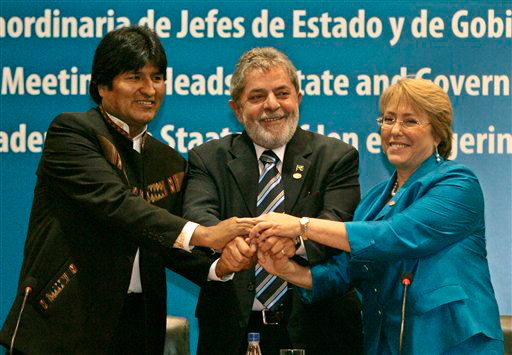
c) Regarding the Defense policy, The South American Defense Council (SADC) (proposed by Venezuela and Brazil) to serve as a NATO-like mechanism for regional security, promoting military co-operation and regional defense.
d) Plans of integration through infrastructure cooperation with the construction of the Interoceanic Highway, (road that pretends to link the Pacific Coast countries, especially Chile and Peru with Brazil and Argentina by the construction of extending highways through the continent, making easier the connections to ports .The construction of the first corridor first between Peru and Brazil, began in September 2005.
e) The idea of Free movement of people which states that visits by any South American citizen to any South American country of up to 90 days only require an identity card issued by the respective authority of the travelers’ country of origin.
Bibliography:
Union of South American Nations. (n.d.). In Wikipedia. Retrieved May 20,2010, from http://en.wikipedia.org/wiki/Union_of_South_American_Nations
Is an intergovernmental union that integrates two existing customs unions as part of a continuing process of South American integration: Mercosur and the Andean Community of nations. It is based on the European union. Its Constitutive Treaty was signed on May 23, 2008; the Union's headquarters are located in Quito, Ecuador. The group has the intention to model the community after the European Union this includes a common currency, a parliament, and a passport, according to studies a complete union like that of the EU should be possible by 2019.One important characteristic in order to prevent bureaucracy is that no new institutions will be created in the first phase
The main ideas of UNASUR ARE:
A) Creation of a single market, with the elimination of tariffs for non-sensitive products by 2014, and for sensitive products by 2019.
b) Economic development through the South American Bank launched by presidents of: Argentina, Bolivia, Brazil, Ecuador, Paraguay, Venezuela and Uruguay, this bank will finance economic development projects to improve local competitiveness and promote the scientific and technological development of the member states.
c) Regarding the Defense policy, The South American Defense Council (SADC) (proposed by Venezuela and Brazil) to serve as a NATO-like mechanism for regional security, promoting military co-operation and regional defense.
d) Plans of integration through infrastructure cooperation with the construction of the Interoceanic Highway, (road that pretends to link the Pacific Coast countries, especially Chile and Peru with Brazil and Argentina by the construction of extending highways through the continent, making easier the connections to ports .The construction of the first corridor first between Peru and Brazil, began in September 2005.
e) The idea of Free movement of people which states that visits by any South American citizen to any South American country of up to 90 days only require an identity card issued by the respective authority of the travelers’ country of origin.
Bibliography:
Union of South American Nations. (n.d.). In Wikipedia. Retrieved May 20,2010, from http://en.wikipedia.org/wiki/Union_of_South_American_Nations
AUSTRALIA
THE STOLEN GENERATIONS:
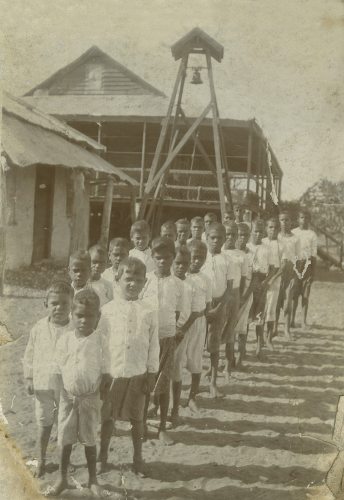
First of all The Stolen Generations refers to those children who were removed from their families by the Australian government agencies and church missioners, under several acts of their respective parliaments. On February 13 2008, Australia’s Prime Minister Kevin Rudd presented the apology to Indigenous Australians:
"Today we honor the Indigenous peoples of this land, the oldest continuing cultures in human history. We reflect on their past mistreatment. We reflect in particular on the mistreatment of those who were Stolen Generations - this blemished chapter in our nation's history. The time has now come for the nation to turn a new page in Australia's history by righting the wrongs of the past and so moving forward with confidence to the future. We apologize for the laws and policies of successive Parliaments and governments that have inflicted profound grief, suffering and loss on these our fellow Australians. We apologize especially for the removal of Aboriginal and Torres Strait Islander children from their families, their communities and their country................................. We today take this first step by acknowledging the past and laying claim to a future that embraces all Australians. A future where this Parliament resolves that the injustices of the past must never, never happen again. A future where we harness the determination of all Australians, Indigenous and non-Indigenous, to close the gap that lies between us in life expectancy, educational achievement and economic opportunity......A future based on mutual respect, mutual resolve and mutual responsibility. A future where all Australians, whatever their origins, are truly equal partners, with equal opportunities and with an equal stake in shaping the next chapter in the history of this great country, Australia"
FROM YOU OWN POINT OF VIEW IS IT USEFUL TO SAY "SORRY" AFTER YEARS OF WRONG POLICIES TOWARDS A MINORITY?WHY? WHAT ELSE IS NEEDED?

To say sorry is one of the hardest thing to say, because If you say you are sorry for something, you are implicitly taking responsibility for whatever has happened, so I think it is useful to say sorry when things are not done in the right way by a government or by anyone else, because an excuse at least means that you recognized you acted wrong, but an excuse is not the only thing to emend a mistake, because for example ,in this case, how useful is to a minority that that the government say he is sorry when he is not really feeling it?, when he doesn’t really regret his acts? or when he is going to do the same thing afterwards keeping the wrong policies?,i think people have to say sorry when they really mean this word and when they are willing to do something to emend their mistakes and make things change, in this case a correction on the wrong policies is also needed, the government needs to recognize that we are all equals ,and treat them as equals, do not violate their rights and ensure they are protected ,not the other way. Just as Kevin Rutt said on the speech governments have to learn from their past bad experiences and look at the future with hope and determination to change, they have to work in order to not commit the same mistakes and injusticies, they have to look for a future with opportunities for everyone, a future with new solutions to the problems of the past.
First of all The Stolen Generations refers to those children who were removed from their families by the Australian government agencies and church missioners, under several acts of their respective parliaments. On February 13 2008, Australia’s Prime Minister Kevin Rudd presented the apology to Indigenous Australians:
"Today we honor the Indigenous peoples of this land, the oldest continuing cultures in human history. We reflect on their past mistreatment. We reflect in particular on the mistreatment of those who were Stolen Generations - this blemished chapter in our nation's history. The time has now come for the nation to turn a new page in Australia's history by righting the wrongs of the past and so moving forward with confidence to the future. We apologize for the laws and policies of successive Parliaments and governments that have inflicted profound grief, suffering and loss on these our fellow Australians. We apologize especially for the removal of Aboriginal and Torres Strait Islander children from their families, their communities and their country................................. We today take this first step by acknowledging the past and laying claim to a future that embraces all Australians. A future where this Parliament resolves that the injustices of the past must never, never happen again. A future where we harness the determination of all Australians, Indigenous and non-Indigenous, to close the gap that lies between us in life expectancy, educational achievement and economic opportunity......A future based on mutual respect, mutual resolve and mutual responsibility. A future where all Australians, whatever their origins, are truly equal partners, with equal opportunities and with an equal stake in shaping the next chapter in the history of this great country, Australia"
FROM YOU OWN POINT OF VIEW IS IT USEFUL TO SAY "SORRY" AFTER YEARS OF WRONG POLICIES TOWARDS A MINORITY?WHY? WHAT ELSE IS NEEDED?
To say sorry is one of the hardest thing to say, because If you say you are sorry for something, you are implicitly taking responsibility for whatever has happened, so I think it is useful to say sorry when things are not done in the right way by a government or by anyone else, because an excuse at least means that you recognized you acted wrong, but an excuse is not the only thing to emend a mistake, because for example ,in this case, how useful is to a minority that that the government say he is sorry when he is not really feeling it?, when he doesn’t really regret his acts? or when he is going to do the same thing afterwards keeping the wrong policies?,i think people have to say sorry when they really mean this word and when they are willing to do something to emend their mistakes and make things change, in this case a correction on the wrong policies is also needed, the government needs to recognize that we are all equals ,and treat them as equals, do not violate their rights and ensure they are protected ,not the other way. Just as Kevin Rutt said on the speech governments have to learn from their past bad experiences and look at the future with hope and determination to change, they have to work in order to not commit the same mistakes and injusticies, they have to look for a future with opportunities for everyone, a future with new solutions to the problems of the past.
miércoles, 12 de mayo de 2010
THE FIVE BLOGS FROM MY CLASS
The 5 blogs from the class I visited are:
-http://www.marianap123.blogspot.com/
I think there are a lot of activities missing in this blog, she only has until the average sales person in Colombia, she is missing the first and second blog review we had to do to the blogs of our classmates and to choose which was the best one, she is also missing the topics we have already covered such as the middle east banking system or the e commerce,Australia,the visit to bobs website and the writing about trade union in Colombia and in Europe, I also think she should make her blog more attractive to the view by putting some pictures ,videos or interesting articles.
-http://melicoulson.blogspot.com/2010/05/europe-and-colombia.html
I think this is a good blog, it has pictures and links to videos, it is organized and attractive to the view, but she is missing the middle east ,Australia and the review of our class blogs activities regarding European trade unions writing ,I like how she introduced the European union and the definition of a trade union, because since the European union is a mixture of different countries, with different customs ,culture ,languages among other things, trade unions in each country are different, and in Colombia since we are talking about just one country with similar people, language and customs things change, so the comparison won’t be always fair.
-http://paulalopezrestrepo.blogspot.com/
Regarding this blog I like the way she justify her answer to the e question of the corporation movie, even thought I don’t agree with her, because I think the root cause of the problem are not only corporations, but capitalism and consumism too, I like how she linked the phrase “the end justifies the means” with the actual problem. I like how she use the Hofstede's analysis to explain the situation of a sales person in Colombia, and the fact that she did an extra activity on the blog which was to write about management style in Colombia and a comparison between this style and the Korean style, but I think that for the date she is missing lots of activities:-Middle East-Australia-European and Colombian trade unions writing-the review about BOB's website blogs and about our classmates blogs, I think she should put some pictures and videos in the blog.
-http://natashacardona.blogspot.com/
I think this is a good blog, I like the introduction she gave to the blog with the phrase:”big thinking proceeds great achievement”, I completely agree with the other phrase too:”To look out with a broader, bigger, and more accurate perspective are the goals that every business man should try to reach in order to create a successfully future, understanding and respecting diversity acknowledging that we are living in a world where people are becoming more and more closely interconnected.”, because I think that in the global world we are living in is important to have a global perspective, an open mind, to understand we live in an interconnected world ,and that we are all different and t6ht we can use those differences to create advantages for the future. The blog has pictures and an interesting video about an apology of Kevin Rutt regarding Australia’s situation towards minorities discrimination, as she said: Kevin Rudd offered a broad apology to all aborigines and the Stolen Generations for their "profound grief, suffering and loss" in a carefully worded statement that was greeted by a standing ovation.
But I think the blog is also missing the Middle East banking system or e commerce writing, the European and Colombian trade unions writing, and the reviews to bobs website blogs and to the blogs of our classmates
BUT MY FAVORITE BLOG FROM THE FIVE IS:

-http://www.carlosvallejod34.blogspot.com/
Because he has the blog updated with all the activities we had to do, he is organized and I like the way he exposed his ideas, they are clear, and the way he justifies his opinions with great arguments, he also has images, charts and a well referenced bibliography. I want to say that I really like his article about the stolen generation on which he justifies that the remedy has been worse than the mistake, exposing certain points for this argument.
I think it is an excellent blog!
-http://www.marianap123.blogspot.com/
I think there are a lot of activities missing in this blog, she only has until the average sales person in Colombia, she is missing the first and second blog review we had to do to the blogs of our classmates and to choose which was the best one, she is also missing the topics we have already covered such as the middle east banking system or the e commerce,Australia,the visit to bobs website and the writing about trade union in Colombia and in Europe, I also think she should make her blog more attractive to the view by putting some pictures ,videos or interesting articles.
-http://melicoulson.blogspot.com/2010/05/europe-and-colombia.html
I think this is a good blog, it has pictures and links to videos, it is organized and attractive to the view, but she is missing the middle east ,Australia and the review of our class blogs activities regarding European trade unions writing ,I like how she introduced the European union and the definition of a trade union, because since the European union is a mixture of different countries, with different customs ,culture ,languages among other things, trade unions in each country are different, and in Colombia since we are talking about just one country with similar people, language and customs things change, so the comparison won’t be always fair.
-http://paulalopezrestrepo.blogspot.com/
Regarding this blog I like the way she justify her answer to the e question of the corporation movie, even thought I don’t agree with her, because I think the root cause of the problem are not only corporations, but capitalism and consumism too, I like how she linked the phrase “the end justifies the means” with the actual problem. I like how she use the Hofstede's analysis to explain the situation of a sales person in Colombia, and the fact that she did an extra activity on the blog which was to write about management style in Colombia and a comparison between this style and the Korean style, but I think that for the date she is missing lots of activities:-Middle East-Australia-European and Colombian trade unions writing-the review about BOB's website blogs and about our classmates blogs, I think she should put some pictures and videos in the blog.
-http://natashacardona.blogspot.com/
I think this is a good blog, I like the introduction she gave to the blog with the phrase:”big thinking proceeds great achievement”, I completely agree with the other phrase too:”To look out with a broader, bigger, and more accurate perspective are the goals that every business man should try to reach in order to create a successfully future, understanding and respecting diversity acknowledging that we are living in a world where people are becoming more and more closely interconnected.”, because I think that in the global world we are living in is important to have a global perspective, an open mind, to understand we live in an interconnected world ,and that we are all different and t6ht we can use those differences to create advantages for the future. The blog has pictures and an interesting video about an apology of Kevin Rutt regarding Australia’s situation towards minorities discrimination, as she said: Kevin Rudd offered a broad apology to all aborigines and the Stolen Generations for their "profound grief, suffering and loss" in a carefully worded statement that was greeted by a standing ovation.
But I think the blog is also missing the Middle East banking system or e commerce writing, the European and Colombian trade unions writing, and the reviews to bobs website blogs and to the blogs of our classmates
BUT MY FAVORITE BLOG FROM THE FIVE IS:
-http://www.carlosvallejod34.blogspot.com/
Because he has the blog updated with all the activities we had to do, he is organized and I like the way he exposed his ideas, they are clear, and the way he justifies his opinions with great arguments, he also has images, charts and a well referenced bibliography. I want to say that I really like his article about the stolen generation on which he justifies that the remedy has been worse than the mistake, exposing certain points for this argument.
I think it is an excellent blog!
TRADE UNIONS IN COLOMBIA AND TRADE UNIONS IN EUROPE
WHAT IS A TRADE UNION?
A trade unions is an organization of workers who joined together to achieve through its leadership common goals specially better working conditions, the union negotiates with the employer on behalf of union members certain specific aspects of the job contract ,aspects such as wages, work rules, complains, rules of the hiring, firing and promotion procedures, benefits, workplace safety and policies.

TRADE UNIONS IN EUROPE
Trade unions originated in Europe, and became popular in many European countries during the Industrial Revolution, when the increase in production and the lack of worker skills necessary to perform well in most jobs leave the employment negotiation power almost completely to the employers' side, this caused mistreatment and underpayment of many One important thing is that trade unions in Europe ,Colombia and almost all around the world , have all the same main purpose which is ” maintaining or improving the conditions of their employment “of course this purpose varies somehow depending on the working environment ,on the legal conditions,on the economic situation of the country we are talking about. Trade unions in Europe reached an enormous development with the performance of activities such as:
-The Provision of benefits to insure members against unemployment, ill health, old age and funeral expenses
-Collective bargaining: they are recognized by employers, and are able to negotiate with them over wages and working conditions.
-Industrial action: they may enforce strikes or resistance to lockouts in order to reach some particular goals.
-Political activity: Trade unions try to promote legislation of laws favorable to the interests of their workers as a whole, by doing campaigns, undertaking lobbying, or by giving financial support to individual candidates for public office.
but over the years there has been a decline in trade unions throughout Europe, Since the fall of the Iron Curtain in 1989, unionization has collapsed, In only 8 out of the current 27 member states of the EU are more than half of the employed population members of a trade union, The average level of union membership across the whole of the European Union, weighted by the numbers employed in the different member states is 24%. The EU's 4 most populated states all have low levels of unionization (Italy 30%, UK 29%, Germany 27% and France only 9%).in Europe 3 out of every 4 people employed are now not members of a trade union. Furthermore, in every EU country outside Scandinavia (except Belgium), trade union membership is either static or in decline. There is an estimation that the average level of unionization across the EU will fall be just fewer than 20% by 2010, but union membership is not the only indicator of the strength of the organization. In countries like Spain, for example, support for the unions is shown by the large number of votes they receive in works council elections, and in France, the unions have shown that despite low levels of membership they are able to mobilise workers in mass strikes and demonstrations of great effect. By another side Denmark, Sweden and Finland are at the top with around 70% of all employees in unions, mainly because unemployment and other social benefits are normally paid out through the union, although recent changes in the Swedish system of unemployment benefit have had a negative impact on union membership. This high union density in the Nordic countries reflects that the union membership is seen as a natural part of employment. But in central and eastern European countries the situation regarding unions is quite different, the climate is hostile toward unions they have below average levels of union membership. Seven of the 10 states in this position have union density levels below the EU average, including the largest, Poland, where 16% of employees are estimated to be union members, and this is not the only worrying thing, what is more worrying is that there are not perspectives of growth for the future, the situation of the labour unions is static, there hasn’t been a strong gain in union members among the employed in recent years, in general in most countries of the EU overall union membership has fallen. The losses are clearest in the states in Central and Eastern Europe, where industrial restructuring and a fundamental change in the role of unions has had a major impact. But there have also been major membership declines in the countries of Western Europe. In Germany, for example, the main union confederation, the DGB, has lost 47% of its membership since its peak in 1991, although the greatest losses were in the former East Germany. One important thing regarding unions belonging is that they grow when the employee belongs to the public sector, for example in the UK union figures are better because there has been a growth in employment in the public sector, where unions are stronger, the same thing happened in Poland, a survey found that union membership was highest at 25% in education, science and health, which are activities of the public sector, and in Sweden, a study undertaken for the largest union confederation LO found that the public sector had the highest level of union membership (between 88% and 90% depending on the type of work )–,while the lowest level was in private services (between 63% and 66%)
But even thought unions in Europe are tending to decrease, those that exist have a good practice of their labor and try to do their best helping their members by:
• Support in undertaking needs analysis and in the development of the career
• Direct help in finding new and better employment and in training and lifelong learning
• Support for staff who is working abroad
• Innovative uses of new technology in communicating with professional and managerial staff
European workers want their contribution at work to be better recognized, they want opportunities to improve their professional skills and qualifications and progress in their careers, they want a more professional but personal approach towards the employer tend the right to participate fully in strategic management decisions affecting their areas of responsibility.
European employment initiatives, have been characterized by the importance of lifelong learning, the actual percentage of European workers obtaining training is really low. One problem for this, is that management thinking continues to view vocational training (for professionals and managerial staff )–as cost, not as an investment, but European Unions contribute in several different ways to the increase in the training processes for members.firstly,for many unions it is a very important issue to set on the bargaining process, just like The Belgian managerial and professional union LBC-NVK said: “Training and retraining are such fundamental rights that we try at all costs to establish these rights in collective agreements, both at company and sector level” . There are several unions that run seminars and courses for managers and employees. A Scandinavian union said: “We help such members to create networks and develop their skills in subjects that are important to them”.
TRADE UNIONS IN COLOMBIA

Trade unions in Colombia ,like in Europe are tending to decrese,but not in the same amount as they are decreasing in the European continent ,maybe because European employers are characterized for being very good employers and try to do their best in order for the employees to feel like at home and perform well at work, the situation in Colombia sometimes is different, there are employees that are not happy with the salary, the subsidies, or the way they are working ,so they form trade unions, in order for workers to pursue their dreams, their aims, to be heard, sometimes strikes and revolts made by unions in Colombia have worked so well that have influenced some government policies.
Another important difference is that trade unions in Colombia are really influenced by the roman catholic church and the catholic religion, so they guide themselves by the catholic church principles, which is different than Europe, a continent with a mixture of religions and a continent where religion doesn’t play the important role it plays in Latin America, so it is common that trade unions are not influenced at all by religious principles.
Many of us think that trade unions in Colombia have been characterized for violence strikes and revolts ,but things have not been like that, the Colombian labor movement ,for example doesn’t have a long history of militant confrontation. This movement has been moderate, fragmented, and closely allied with the traditional parties or the Roman Catholic Church, but it has never accounted for more than one-third of the organized labor force, which itself represented only about 1/5 of the total labor force. In 1988 only 12 % of Colombia's economically active population was unionized. In the decade of the 1980s Situations like an increasing inflation, government corruption, and high unemployment increased labor militancy, but the labor legislation developed so much that it permitted the government a great amount of control over the labor movement. Legislation in Colombia gave priority to company-level unions by requiring them to negotiate at the company level, rather than at the industry level

One of the most important trade unions in our country is Unión de Trabajadores Colombianos,a central trade union confederation founded by the Jesuit elements of the Roman Catholic Church , based on Catholic social doctrine. Both industrialists and the Conservative government supported the UTC, mainly because it did not represent a threat to the political and economic elite.
The situation of trade unionists in Colombia has been hard. In the recent years hundreds of trade union activists have been murdered for the simple fact of belonging to a trade union and being involved on its activities. But one very good aspect regarding trade unions in Colombia is that to fight against violence and reach their goals many unions have received support from trade unions all around the world ,unions such as LO (Norway); UNISON (UK); SEIU (USA); IMPACT (Ireland); CAW (Canada); CEP (Canada); Amnesty International (UK); UNI (International); Garden Court barristers’ chambers (UK); Matrix barristers’ chambers (UK);and IMF metalworkers (International) among others.
Francisco maltes Tello (2010, April 27). Continua la lucha por la estabilidad laboral de los empleados públicos. Retrieved APRIL 30, 2010, from CUT website:http://www.cut.org.co/index.php?option=com_content&view=article&id=92:continua-la-lucha-por-la-estabilidad-laboral-de-los-empleados-publicos&catid=47:departamento-de-comunicaciones-publicidad-y-propaganda&Itemid=55
L. Fulton (2009) Worker representation in Europe. Labour Research Department and ETUI (online publication).retrieved may 9, 2010 from worker-participation website: http://www.worker-participation.eu/National-Industrial-Relations/Across-Europe/Trade-Unions2
Trade unions in Colombia. (n.d.). In Wikipedia. Retrieved May 1,
2010, from http://en.wikipedia.org/wiki/Special:Search/Trade_unions_in_Colombia
Trade unions in Europe. (n.d.). In Wikipedia. Retrieved May 1,
2010, from http://en.wikipedia.org/wiki/Trade_union#Europe
A trade unions is an organization of workers who joined together to achieve through its leadership common goals specially better working conditions, the union negotiates with the employer on behalf of union members certain specific aspects of the job contract ,aspects such as wages, work rules, complains, rules of the hiring, firing and promotion procedures, benefits, workplace safety and policies.
TRADE UNIONS IN EUROPE
Trade unions originated in Europe, and became popular in many European countries during the Industrial Revolution, when the increase in production and the lack of worker skills necessary to perform well in most jobs leave the employment negotiation power almost completely to the employers' side, this caused mistreatment and underpayment of many One important thing is that trade unions in Europe ,Colombia and almost all around the world , have all the same main purpose which is ” maintaining or improving the conditions of their employment “of course this purpose varies somehow depending on the working environment ,on the legal conditions,on the economic situation of the country we are talking about. Trade unions in Europe reached an enormous development with the performance of activities such as:
-The Provision of benefits to insure members against unemployment, ill health, old age and funeral expenses
-Collective bargaining: they are recognized by employers, and are able to negotiate with them over wages and working conditions.
-Industrial action: they may enforce strikes or resistance to lockouts in order to reach some particular goals.
-Political activity: Trade unions try to promote legislation of laws favorable to the interests of their workers as a whole, by doing campaigns, undertaking lobbying, or by giving financial support to individual candidates for public office.
but over the years there has been a decline in trade unions throughout Europe, Since the fall of the Iron Curtain in 1989, unionization has collapsed, In only 8 out of the current 27 member states of the EU are more than half of the employed population members of a trade union, The average level of union membership across the whole of the European Union, weighted by the numbers employed in the different member states is 24%. The EU's 4 most populated states all have low levels of unionization (Italy 30%, UK 29%, Germany 27% and France only 9%).in Europe 3 out of every 4 people employed are now not members of a trade union. Furthermore, in every EU country outside Scandinavia (except Belgium), trade union membership is either static or in decline. There is an estimation that the average level of unionization across the EU will fall be just fewer than 20% by 2010, but union membership is not the only indicator of the strength of the organization. In countries like Spain, for example, support for the unions is shown by the large number of votes they receive in works council elections, and in France, the unions have shown that despite low levels of membership they are able to mobilise workers in mass strikes and demonstrations of great effect. By another side Denmark, Sweden and Finland are at the top with around 70% of all employees in unions, mainly because unemployment and other social benefits are normally paid out through the union, although recent changes in the Swedish system of unemployment benefit have had a negative impact on union membership. This high union density in the Nordic countries reflects that the union membership is seen as a natural part of employment. But in central and eastern European countries the situation regarding unions is quite different, the climate is hostile toward unions they have below average levels of union membership. Seven of the 10 states in this position have union density levels below the EU average, including the largest, Poland, where 16% of employees are estimated to be union members, and this is not the only worrying thing, what is more worrying is that there are not perspectives of growth for the future, the situation of the labour unions is static, there hasn’t been a strong gain in union members among the employed in recent years, in general in most countries of the EU overall union membership has fallen. The losses are clearest in the states in Central and Eastern Europe, where industrial restructuring and a fundamental change in the role of unions has had a major impact. But there have also been major membership declines in the countries of Western Europe. In Germany, for example, the main union confederation, the DGB, has lost 47% of its membership since its peak in 1991, although the greatest losses were in the former East Germany. One important thing regarding unions belonging is that they grow when the employee belongs to the public sector, for example in the UK union figures are better because there has been a growth in employment in the public sector, where unions are stronger, the same thing happened in Poland, a survey found that union membership was highest at 25% in education, science and health, which are activities of the public sector, and in Sweden, a study undertaken for the largest union confederation LO found that the public sector had the highest level of union membership (between 88% and 90% depending on the type of work )–,while the lowest level was in private services (between 63% and 66%)
But even thought unions in Europe are tending to decrease, those that exist have a good practice of their labor and try to do their best helping their members by:
• Support in undertaking needs analysis and in the development of the career
• Direct help in finding new and better employment and in training and lifelong learning
• Support for staff who is working abroad
• Innovative uses of new technology in communicating with professional and managerial staff
European workers want their contribution at work to be better recognized, they want opportunities to improve their professional skills and qualifications and progress in their careers, they want a more professional but personal approach towards the employer tend the right to participate fully in strategic management decisions affecting their areas of responsibility.
European employment initiatives, have been characterized by the importance of lifelong learning, the actual percentage of European workers obtaining training is really low. One problem for this, is that management thinking continues to view vocational training (for professionals and managerial staff )–as cost, not as an investment, but European Unions contribute in several different ways to the increase in the training processes for members.firstly,for many unions it is a very important issue to set on the bargaining process, just like The Belgian managerial and professional union LBC-NVK said: “Training and retraining are such fundamental rights that we try at all costs to establish these rights in collective agreements, both at company and sector level” . There are several unions that run seminars and courses for managers and employees. A Scandinavian union said: “We help such members to create networks and develop their skills in subjects that are important to them”.
TRADE UNIONS IN COLOMBIA
Trade unions in Colombia ,like in Europe are tending to decrese,but not in the same amount as they are decreasing in the European continent ,maybe because European employers are characterized for being very good employers and try to do their best in order for the employees to feel like at home and perform well at work, the situation in Colombia sometimes is different, there are employees that are not happy with the salary, the subsidies, or the way they are working ,so they form trade unions, in order for workers to pursue their dreams, their aims, to be heard, sometimes strikes and revolts made by unions in Colombia have worked so well that have influenced some government policies.
Another important difference is that trade unions in Colombia are really influenced by the roman catholic church and the catholic religion, so they guide themselves by the catholic church principles, which is different than Europe, a continent with a mixture of religions and a continent where religion doesn’t play the important role it plays in Latin America, so it is common that trade unions are not influenced at all by religious principles.
Many of us think that trade unions in Colombia have been characterized for violence strikes and revolts ,but things have not been like that, the Colombian labor movement ,for example doesn’t have a long history of militant confrontation. This movement has been moderate, fragmented, and closely allied with the traditional parties or the Roman Catholic Church, but it has never accounted for more than one-third of the organized labor force, which itself represented only about 1/5 of the total labor force. In 1988 only 12 % of Colombia's economically active population was unionized. In the decade of the 1980s Situations like an increasing inflation, government corruption, and high unemployment increased labor militancy, but the labor legislation developed so much that it permitted the government a great amount of control over the labor movement. Legislation in Colombia gave priority to company-level unions by requiring them to negotiate at the company level, rather than at the industry level
One of the most important trade unions in our country is Unión de Trabajadores Colombianos,a central trade union confederation founded by the Jesuit elements of the Roman Catholic Church , based on Catholic social doctrine. Both industrialists and the Conservative government supported the UTC, mainly because it did not represent a threat to the political and economic elite.
The situation of trade unionists in Colombia has been hard. In the recent years hundreds of trade union activists have been murdered for the simple fact of belonging to a trade union and being involved on its activities. But one very good aspect regarding trade unions in Colombia is that to fight against violence and reach their goals many unions have received support from trade unions all around the world ,unions such as LO (Norway); UNISON (UK); SEIU (USA); IMPACT (Ireland); CAW (Canada); CEP (Canada); Amnesty International (UK); UNI (International); Garden Court barristers’ chambers (UK); Matrix barristers’ chambers (UK);and IMF metalworkers (International) among others.
Francisco maltes Tello (2010, April 27). Continua la lucha por la estabilidad laboral de los empleados públicos. Retrieved APRIL 30, 2010, from CUT website:http://www.cut.org.co/index.php?option=com_content&view=article&id=92:continua-la-lucha-por-la-estabilidad-laboral-de-los-empleados-publicos&catid=47:departamento-de-comunicaciones-publicidad-y-propaganda&Itemid=55
L. Fulton (2009) Worker representation in Europe. Labour Research Department and ETUI (online publication).retrieved may 9, 2010 from worker-participation website: http://www.worker-participation.eu/National-Industrial-Relations/Across-Europe/Trade-Unions2
Trade unions in Colombia. (n.d.). In Wikipedia. Retrieved May 1,
2010, from http://en.wikipedia.org/wiki/Special:Search/Trade_unions_in_Colombia
Trade unions in Europe. (n.d.). In Wikipedia. Retrieved May 1,
2010, from http://en.wikipedia.org/wiki/Trade_union#Europe
jueves, 6 de mayo de 2010
EUROPE:BOB's WEBSITE FAVORITE BLOG
I visited Bob’s website and I had access to several blogs, this are the 5 I visited:
1)http://www.peaceforgaza.blogspot.com/
2)http://www.alt1040.com/
3)http://obsthisland.blogspot.com/
4)http://www.mappingmainstreet.org/blog/topics/main-street-stories/san-luis-az/
5)http://malviviendo.com/
The second one was the one I liked the most for 2 main reasons:1)I think the topic of the blog is really interesting and contemporary, it talks mainly about technological topics such as the introduction of the first WebPages in Arab, Google most searched women, iTunes future on music, among other important topics, but the blog also has news regarding the actual world, it talks about the ecological disaster in the gulf of Mexico and about the Nasa subacquatic mission in Key Large Florida ,I like that they called it the geek guide, and in fact it is, I am more than sure that a lot of nerds have access to this blog and have read a lot of interesting things,2)I also like the organization of the blog, and how it has access to facebook, twitter, feed, science, technology, astronomy and a window to search, the blog is very nice to the view, because it has a lot of pictures ,graphics and videos.

But I want to share with all of you this blog which was not on BOB’s website,but which I consider is the best:
1) http://florian-kolumbien.blogspot.com/
It was made by a friend of mine, Florian Wenzelburger,a German Exchange student in Eafit,who travelled all around the country(Amazonas,Guajira,Eje cafetero,Santander ,Rio claro….) and fell in love with it and its people, he relates each of his experiences in each different place he visited and it has really nice pictures of our country, I think the blog is a very good way to introduce our country and to show it to people that doesn’t know it, I think the visitors after watching will want to come to Colombia someday in the future. I also like this blog because it not only shows touristic places, but it relates how the daily life in Medellin and in Eafit is, it talks about the academic, social and cultural life. The blog also emphasizes on how the trip to Colombia was an opportunity to travel to other Latin American countries such as Brazil and Argentina, so it is a contrast between this countries and ours. I really recommend you to visit this blog.

1)http://www.peaceforgaza.blogspot.com/
2)http://www.alt1040.com/
3)http://obsthisland.blogspot.com/
4)http://www.mappingmainstreet.org/blog/topics/main-street-stories/san-luis-az/
5)http://malviviendo.com/
The second one was the one I liked the most for 2 main reasons:1)I think the topic of the blog is really interesting and contemporary, it talks mainly about technological topics such as the introduction of the first WebPages in Arab, Google most searched women, iTunes future on music, among other important topics, but the blog also has news regarding the actual world, it talks about the ecological disaster in the gulf of Mexico and about the Nasa subacquatic mission in Key Large Florida ,I like that they called it the geek guide, and in fact it is, I am more than sure that a lot of nerds have access to this blog and have read a lot of interesting things,2)I also like the organization of the blog, and how it has access to facebook, twitter, feed, science, technology, astronomy and a window to search, the blog is very nice to the view, because it has a lot of pictures ,graphics and videos.
But I want to share with all of you this blog which was not on BOB’s website,but which I consider is the best:
1) http://florian-kolumbien.blogspot.com/
It was made by a friend of mine, Florian Wenzelburger,a German Exchange student in Eafit,who travelled all around the country(Amazonas,Guajira,Eje cafetero,Santander ,Rio claro….) and fell in love with it and its people, he relates each of his experiences in each different place he visited and it has really nice pictures of our country, I think the blog is a very good way to introduce our country and to show it to people that doesn’t know it, I think the visitors after watching will want to come to Colombia someday in the future. I also like this blog because it not only shows touristic places, but it relates how the daily life in Medellin and in Eafit is, it talks about the academic, social and cultural life. The blog also emphasizes on how the trip to Colombia was an opportunity to travel to other Latin American countries such as Brazil and Argentina, so it is a contrast between this countries and ours. I really recommend you to visit this blog.
THE BANKING SYSTEM IN THE MIDDLE EAST

Islamism is one of the most important religions in the world, according to the World Factbook of the CIA, in the year 2005 Islamism was the second religion, after Christianity, with more believers in the world, approximately 19,9% of the total world population. it is estimated that the Muslim population exceeds 1200 million people,18% of the Muslims are located in the Middle East, another 205 is located in Africa ,and 30% in the Indian subcontinent, Pakistan and Bangladesh, there are also important groups of Muslims in China, Europe, Central Asia and Russia.Converts and immigrant communities are spread all around the world.Islamism is not only important because it has millions and millions of followers, but because it has reached a lot of people and has influenced the globalization process in a number of ways. the religion has growth amazingly during the past years ,at the moment Islamism is the fastest growing religion in the world, and its countries are playing a very important role in the world’s economy, the OPEP for example, dominates the world’s oil prices, but it is important to understand that Islamism is a religion that influences each and every single aspect of the believer, it is not like Catholicism were we profess we believe in God and sometimes in our daily life we don’t even remember his existence, God is present in every aspect of the life, the economic system in the middle east is fully affected by the religion, the religion is an active part of the system ,it has a complete relation with the believes, for them the economic activity is worship ,for them, work must be done with good intention and according to the laws, Islamism avoids corruption, stealing, cheating and job deficiency, Muslims are conscious that the boss is not always around but they have an excellence performance because they know god sees it all.
The banking sector in the Middle East is composed by commercial bank markets and the ease of access to bank credit. In some countries, the banking sector is well developed, profitable, and efficient, In other countries the banking sector is dominated by public sector banks (characterized by government intervention in liquidity issues, credit allocation and interest rates) the middle east banking system has been characterized by promoting growth and this is highly recognized, right now the region counts with is a large and competitive banking sector, and liquid and active equity and debt markets, that operate according to market Islamic principles, this high development on the banking system has increased the promotion of efficiency in allocating investments, and by doing so, has also increase the productivity by: Improving the management of risk, Identifying productive projects and efficient firms, and mobilizing savings among other things.
Islamic banking is consistent with the principles of the Islamic law and the development of eeconomics, according to the same law. Sharia,for example, forbids the acceptance or payment of interest fees for the lending and accepting of money respectively, (this is way different than the occidental world banking system, were a person can easily get ruined if the interest fees are not paid, usury is also forbidden, as well as investing in businesses that provide services or goods that are considered contrary to its principles .In the earlier times this principles were used as the basis to construct the economic system, but in the banking system they were not applied until late 20th century, were a number of Islamic banks were formed as private or semi-private entities, with the application of these principles. Nowadays the Middle East banking system is one of the world's fastest growing systems. The high education of the population and the strong believes on the Islamic principles are increasing the demand of financial products, which is generating diversity on the offers. Along with the growing banking system, the regulatory requirements for better monitoring of processes and to develop safe financial systems are increasing, for all of this reasons the middle east banking system has reached a good role in the world, by being characterized by its honesty and respect for customers, without no doubt banks and financial institutions in the middle east play a very important role in today’s international banking system. As we see the middle east banking system has become important not only because Islamic banks are a different developing and growing option to occidental banks, but because there are a lot of important Arab investors that have invested in the united states and Europe contributing to the development of those 2 banking systems.
There is one important thing I want to clarify, Islamic banking has the same purpose as conventional banking, but the only different thing is that it operates according to the rules of Shariah(Islamic rules on transactions). The basic principle is the sharing of profit and loss and the prohibition of riba(usury). In an Islamic mortgage transactions, for example, the bank's profit can’t be made explicit and there are no additional penalties for late payment, since the system is restricted to the Islamic religion , every transaction must be acceptable by the it ,so transactions related with alcohol, gambling, and pork are forbidden, the purpose of the system is only to engage on ethical investing, and moral purchasing, and this is promoted on the whole society, Muslims avoid consumism and high expending without no particular reasons, this is why saving is promoted so much and is an important precept in the daily life of every Muslim, they are prohibited to spend on forbidden things and on high amounts of a certain thing, and the banking system is mainly ruled by this important economic and religious principle: spending according to god’s legislation: because in Islamism the money and the goods can be a bless or a discord, they say that money shouldn’t be men’s main objective, men must have the money on the hand ,but not on the heart and they recognize that everything they have is not for their merits but because god want it that way, so as we see the application of all this beliefs gives us some of the reasons why the system is so successful right now.
THE "TOP 25 MIDDLE EAST BANKS"

Sayyid Tahir (2007) .islamic banking theory and practice: a survey and bibliography of the1995-2005 literature ,journal of economic cooperation,1-72.
Islam.(n.d) In Wikipedia. Retrieved April 28 ,2010, from http://es.wikipedia.org/wiki/Islam
Islamic banking .(n.d) In Wikipedia. Retrieved April 28 ,2010, from http://en.wikipedia.org/wiki/Islamic_banking
miércoles, 21 de abril de 2010
THE ARAB-ISRAELI CONFLICT

Do you think someday the arabs will accept israel's jewsih identity?
The arab-israeli conflict is a root historic religious conflict that is implicit in the mind of every Arabian, they have implicit in their minds that they have to be enemies of the Israelis :“It is not a mistake that the Koran warns us of the hatred of the Jews and put them at the top of the list of the enemies of Islam. Today the Jews recruit the world against the Muslims and use all kinds of weapons. They are plundering the dearest place to the Muslims, after Mecca and Medina and threaten the place the Muslims have faced at first when they prayed and the third holiest city after Mecca and Medina. They want to erect their temple on that place....The Muslims are ready to sacrifice their lives and blood to protect the Islamic nature of Jerusalem and al-Aksa!” , so it is very unlikely to say that Israel’s Arab citizens, will someday accept the state's Jewish identity,they have 5 resolutions regarding the jewish,5 resolutions that will never change: ”1.the Jewish are the enemies of the humanity, 2.the Jewish have been awful throughout history. Their bible is full of scandals and liberty without limits reveal the true identity of their nation, it is a lie that spoils god’s message, 3.jewish are dross and they don’t constitute a legitimate nation, 4.israel state must be destroyed because it is the culmination of the historical and cultural depravation of the Jewish, its existence is a total contradiction to the islam, 5.islam is superior. Its greatness guaranties its future triumph over the other religions and villages”
Even though now there are several efforts to end discrimination against them, discrimination and confrontations will continue,: Israel will continue in conflict with the Palestinians and the creation a Palestinian state won’t viable either because of the continuous conflict. As long as the Arabs and the Jewish don’t change their point of views, thoughts, believes and perceptions the conflict will continue, so it will be very hard to create a Palestinian state.

It is also unlikely to say that Israel will enjoy of good relations and strong trade links with most of the Middle East, because of the Islamic believes just mentioned above regardinjg the Jewish and because as long as Israel is supported by the United States and the United States remains Israel’s first trading partner and supporter, tensions will not end. Israel is seeing as a threat and an enemy by the Middle East because of its relations with the United States ,( when the cold war started the Arabs joined forces with the Russians and the Jewish joined forces with the United States),and now even though the Cold War has ended ,there is still the tension between this 2 superpowers ,we have to remember that Israel is an strategic location rich in petroleum and with an increasing economy, and as we know the economic interest and domain and power anxiety grows everyday within the superpowers, this is another reason why the tension is very unlikely to end, another important thing regarding the Jewish is that after the second world war Jewish are determined to do whatever they have to do to protect what they own, to protect their land, because for them land is not just a material thing, for them it is the promised land and they won’t accept Arabs attacks towards them. “Many Israelis considered that the predominant Palestinian views of peace process do not recognize Israel’s right to exist and believe the only real long term Arab goal is the complete destruction of the Arab state”
In the future Islamic fundamentalism will grow, because it is the religious contrincant against Zionism, Islamic fundamentalism in the region is seen as a way to fight against the Jewish, because if there are more and more Arabs in the region, it is easily to spread the Islamic religion and extinguish Little by Little the Zionism.

As a conclusion I can say that because of all these reasons any peace arrangement will be unlikely to occur and if it does it will be very unstable and weak. “All signs unequivocally prove that the conflict between the Jews and the Muslims is an eternal on-going conflict, even if it stops for short intervals.... This conflict resembles the conflict between man and Satan.... This is the fate of the Muslim nation, and beyond that the fate of all the nations of the world, to be tormented by this nation [the Jews]. The fate of the Palestinian people is to struggle against the Jews on behalf of the Arab peoples, the Islamic peoples and the peoples of the entire worlds.”
viernes, 16 de abril de 2010
LEADERSHIP & VALUES
Hey everyvody! i want to share this analyses of Ikea's owner Ingvar Kamprad – swedish leadership style

Ingvar Kamprad is the founder and chairman of IKEA. He was born in 1926 in Småland, a province situated in the south of Sweden. As a young boy, he was involved in different business projects such as buying matches in a bulk from Stockholm, selling them individually at a low price in his hometown, but still making a good profit . when he was 17, his fahter gave him some money,for his good grades,money he used to establish his own business – IKEA. The “IK” in IKEA comes from the founder’s name, whereas the E and the A mean “Elmtaryd” and “Agunnaryd” are the farm and the village were Kamprad grew up.
Today Kamprad is a billionaire and the richest person in Sweden. However, what makes him stand out is his practice of MODESTY. He drives a 13 year old Volvo, flies economy class, avoids luxury hotels and frequents cheap restaurants. He writes on both sides of a paper and he doesn’t have his own private office. As for flying economy class, which he encourages all his employees to do, he says “I could regularly travel first class, but having money in abundance doesn’t seem like a good reason to waste it.” “Why should I choose first class? To be offered a glass of champagne from the air hostess? If it helped me arrive at my destination more quickly, then maybe.”
In a survey, 800 Swedish managers were asked which Swedish person they would prefer as their leader; 63% of them chose Ingvar Kamprad. As he is so successful and different, we are going to take a closer look at his leadership style using a few of the Globe’s leadership dimensions.

ASSERTIVENESS - Kamprad prefers harmony, loyalty and solidarity with his co-workers. He believes that they are IKEA’s most important resource and therefore that it is vital that they have fun and enjoy their work.
FUTURE ORIENTATION - Kamprad is known for being tight with money. He drives a 13 year old Volvo and whenever he buys something, even a post card, he asks himself if IKEA and it’s customers can afford it. Because everything IKEA earn, they need as a reserve for the future when IKEA will expand and enter new markets. Also, IKEA has not been listed on the stock exchange because Kamprad doesn’t want the short-term thinking that might bring.
HUMAN ORIENTATION - There is not a lot of rewarding for just being fair or generous since that is what he simply expects of you.
GENDER EGALITARIANISM - for Swedes any sort of egalitarianism is very important. Had he not found this question important the chance is very little that he would have had the success that he has had in Sweden.
POWER DISTANCE- low. Kamprad encourages and listens to his co-workers, he doesn’t have an own private office and he flies economy class as the rest of his employees.
UNCERTAINTY AVOIDANCE-high. As mentioned earlier, Kamprad thinks through everything he does and buys and asks himself if he, IKEA and its customers can afford it.
So why is he successful as a leader then? Kamprad himself thinks that in order to be a good leader, one has to be a good example. Some of IKEA’s values are egalitarianism, simplicity, humbleness, hard work and no waste. Those values are also the values of Ingvar Kamprad. He doesn’t only say it, he means it and proves it. He expect his co-workers to work hard and have a strong character, but in order to inspire them he must show them it is possible. In other words, he gives a good example. Also, reading about Kamprad one understands that he really cares about IKEA, IKEA’s future, customers and co-workers. He is no hypocrite and doesn’t do it for the money. All this makes him much more believable and trustworthy as a leader.

Ingvar Kamprad is the founder and chairman of IKEA. He was born in 1926 in Småland, a province situated in the south of Sweden. As a young boy, he was involved in different business projects such as buying matches in a bulk from Stockholm, selling them individually at a low price in his hometown, but still making a good profit . when he was 17, his fahter gave him some money,for his good grades,money he used to establish his own business – IKEA. The “IK” in IKEA comes from the founder’s name, whereas the E and the A mean “Elmtaryd” and “Agunnaryd” are the farm and the village were Kamprad grew up.
Today Kamprad is a billionaire and the richest person in Sweden. However, what makes him stand out is his practice of MODESTY. He drives a 13 year old Volvo, flies economy class, avoids luxury hotels and frequents cheap restaurants. He writes on both sides of a paper and he doesn’t have his own private office. As for flying economy class, which he encourages all his employees to do, he says “I could regularly travel first class, but having money in abundance doesn’t seem like a good reason to waste it.” “Why should I choose first class? To be offered a glass of champagne from the air hostess? If it helped me arrive at my destination more quickly, then maybe.”
In a survey, 800 Swedish managers were asked which Swedish person they would prefer as their leader; 63% of them chose Ingvar Kamprad. As he is so successful and different, we are going to take a closer look at his leadership style using a few of the Globe’s leadership dimensions.
ASSERTIVENESS - Kamprad prefers harmony, loyalty and solidarity with his co-workers. He believes that they are IKEA’s most important resource and therefore that it is vital that they have fun and enjoy their work.
FUTURE ORIENTATION - Kamprad is known for being tight with money. He drives a 13 year old Volvo and whenever he buys something, even a post card, he asks himself if IKEA and it’s customers can afford it. Because everything IKEA earn, they need as a reserve for the future when IKEA will expand and enter new markets. Also, IKEA has not been listed on the stock exchange because Kamprad doesn’t want the short-term thinking that might bring.
HUMAN ORIENTATION - There is not a lot of rewarding for just being fair or generous since that is what he simply expects of you.
GENDER EGALITARIANISM - for Swedes any sort of egalitarianism is very important. Had he not found this question important the chance is very little that he would have had the success that he has had in Sweden.
POWER DISTANCE- low. Kamprad encourages and listens to his co-workers, he doesn’t have an own private office and he flies economy class as the rest of his employees.
UNCERTAINTY AVOIDANCE-high. As mentioned earlier, Kamprad thinks through everything he does and buys and asks himself if he, IKEA and its customers can afford it.
So why is he successful as a leader then? Kamprad himself thinks that in order to be a good leader, one has to be a good example. Some of IKEA’s values are egalitarianism, simplicity, humbleness, hard work and no waste. Those values are also the values of Ingvar Kamprad. He doesn’t only say it, he means it and proves it. He expect his co-workers to work hard and have a strong character, but in order to inspire them he must show them it is possible. In other words, he gives a good example. Also, reading about Kamprad one understands that he really cares about IKEA, IKEA’s future, customers and co-workers. He is no hypocrite and doesn’t do it for the money. All this makes him much more believable and trustworthy as a leader.
miércoles, 24 de marzo de 2010
AN AVERAGE SALESPERSON IN COLOMBIA

1. Organizational Commitment
Affective commitment in a salesperson in Colombia is high, employees believe in the company they are working for, they believe in what they are selling, and they know, accept and live the organization’s goals and values, they are really hardworking and sometimes if it is required by the job, they work extra hours or made several extra work efforts for the good development of the organization
Continuance commitment: the willingness to continue to work in the organization is high, employees try to do everything to preserve their jobs, since sometimes getting a job is really hard, but sometimes there are exceptions, this is the case for example of a salesperson that receives a better job offer, in this case he/she quite the job, to work in the other one with higher payment, so sometimes the continuance to commitment is not that high
2. Leadership Behaviors
Since we are a collective society, we tend to work in groups, in that way consideration is high, managers promote subordinates trust and respect for subordinates ideas, feelings and thoughts, employees respect other’s feelings and believe in their ideas, this help them perform well and makes the working environment nice, if they trust and believe in the other they can work easily together towards the same objectives
Leaders of organizations tend to be human oriented, very collective and with high performance orientation, this means leaders encourage their subordinates to work well, giving them rewards, generating company belonging and making them feel passion on what they are doing. Leaders promote trust and respect among the salespersons for their ideas and feelings, in that what they do not question what the supervisor is saying, and fights and misunderstandings are avoided, regarding the initiation to structure a salesperson in Colombia has very clear his/her responsibilities job-related activities, specific procedures and tasks, because they are well assigned by the subordinates in previous stages ,in this way they work more efficiently and conflicts of 2 or more doing the same thing, attending the same customer or solving the same problem are avoided.
3. Role Stress
Role Ambiguity is not high ,salespersons in Colombia have adequate information in order to perform correctly their tasks, a salesperson has to know the company he /she is working for and the products they are selling in order to abord correctly the customers and make them feel satisfied with their service
Role Conflicts are sometimes common because some employees or supervisors can take attributions they don’t have, conflict arises when a salesperson, for example is demanded by the supervisor to perform certain activity in the store related with the inventory, and then also demanded by the cashier to do another activity, what should the salesperson do? Sometimes it is common for them to encounter different demands from different mangers across the organization and from different customers demanding those different things, this can be quite stressful.
4) Cultural factors affecting the perception of leadership:
There are 2 things quite important in a cultura: individualism and power distance.
Hofstede said that Cultures with High power distance tend to display low individualism, and this is exactly the case of Colombia:
Individualism: Colombia in general is a society with low individualism, this indicates that we are collective; this is reflected on a salesperson salesperson close long-term commitment to the member 'group', the family, the company, the extended family, the extended relationship, among others. salespersons in Colombia really feel they belong to something, that they are part of a company that is like a family, all of employees work together towards the same objectives, and they help each other if there are problems with some issue, a salesperson in Colombia can take the responsibility of another one if there is an inconvenient, and the other person cant attend work. Another important thing is that employees are also very loyal toward the company and their fellowship friends; if someone needs to be covered up it is covered up by one friend.

Power distance: Colombia has high power distance, in the case salespersons this means they prefer the supervisor to indicate everything that needs to be done, they cannot take work attributions or decide in what issue are they going to work today, for employees it is sometimes hard to think they are going to escalate in the hierarchical pyramid, they see the boss or supervisor status very far from their own status.

miércoles, 3 de marzo de 2010
Blogs Review
Hello,i am going to give a small opinion on each blog i visited and then i am going to explain which one ,in my opinion is the best and why
http://carval.tumblr.com/
-About his blog I really liked the introduction he gave to everyone about the blog, and how he motivate people to post their opinions in it, this gives the motivation to post, not just to visit the blog and leave. I like the fact that it has different quotes regarding the subject, but what I didn’t like is that it has no pictures at all; I think he should put some pictures in order to make it more attractive to the view. I must say that I really like how he relate corporate culture with national identity, and that I agree with him in the explanation he gave about if corporations, capitalism or consumism were the root cause of the problem, cause I also agree that both 3 are extremely interconnected capitalism as he days generates economical growth ,which generates consumism, to which corporations respond trying to sell more and more to supply the consumers demands, and as I said on my blog it is a continuous chain, without and apparent end.
http://se-luna.blogspot.com/2010/02/managing-diversity-values-and-attitudes.html
-About this blog I don’t like that it has no pictures related to the topic, but besides that I think the content is really interesting, regarding the relation she gave about corporate culture and national identity ,I totally understand her, I like how she used her personal experience here in EAFIT, to answer the question, how she took EAFIT and AJOU university as corporations to explain that each has its own corporate culture, which is influenced by the country in which they are located (Colombia and Korea)and how for her as Korean has been hard dealing with the corporate culture here in EAFIT, since she was used to Ajou’s corporate culture(influenced by Korea’s political,social,economical and cultural environment)
http://davideafit89.blogspot.com/2010/02/httpwww.html
-About this blog I don’t like that it has no colors, so it is not attractive, it is just White, too simple I think, what I do like is that it has pictures regarding each entry, I like the pictures he used to describe what culture is, and the graphic to explain corporate culture, I also agree with him on the answer he gave to the question about corporations, capitalism and consumism, for him also, both three are the root cause of the problem, cause they are connected one with another.
http://danitamayo000.blogspot.com/
-About this blog I like its color, but I don’t like that it has no pictures ,and that part of it is in spanish,the blog name should be organizations and cultures and it should be all developed in English.

http://vivianamejiasaenz.blogspot.com/
-From the 5 blogs I have seen this is my favorite one, it is very colorful and has lots of pictures, even the writings of each question is in different colors which makes it beautiful and attractive, but I think she should have put the name of the subject organizations and cultures as the name of the blog, not her name, cause in that way we will know what the blog is about.
Regarding the definition of culture I like the fact that she gave her own definition of culture, she explain what she thinks culture is, and then in another entry she published the web definitions of culture, which are with their respective bibliography like the relation she made between corporate culture and national identity ,and the answer she gave about the corporation movie, on which she said both three are the cause of the problem ,as I also did, for the reasons that I just mentioned above. I like the fact that for example, the teacher didn’t ask us, to give our own definitions of culture, but she did them as an extra thing to the blog, and that is very good, cause we don’t have to always stick up to what the teacher tells us and just do that, it is our blog and if we find an interesting article, video, pictures or if we want to express our opinion about certain topic we can do it so.
After visiting the 5 blogs I realized that much students just stick to what the teacher tells us to do, and do not go beyond, trying to make the blog attractive to the view, interesting and beautiful, this is a mistake and I think it should be corrected, Viviana’s blog is different than the others and this is why I chose it as the best one.
http://carval.tumblr.com/
-About his blog I really liked the introduction he gave to everyone about the blog, and how he motivate people to post their opinions in it, this gives the motivation to post, not just to visit the blog and leave. I like the fact that it has different quotes regarding the subject, but what I didn’t like is that it has no pictures at all; I think he should put some pictures in order to make it more attractive to the view. I must say that I really like how he relate corporate culture with national identity, and that I agree with him in the explanation he gave about if corporations, capitalism or consumism were the root cause of the problem, cause I also agree that both 3 are extremely interconnected capitalism as he days generates economical growth ,which generates consumism, to which corporations respond trying to sell more and more to supply the consumers demands, and as I said on my blog it is a continuous chain, without and apparent end.
http://se-luna.blogspot.com/2010/02/managing-diversity-values-and-attitudes.html
-About this blog I don’t like that it has no pictures related to the topic, but besides that I think the content is really interesting, regarding the relation she gave about corporate culture and national identity ,I totally understand her, I like how she used her personal experience here in EAFIT, to answer the question, how she took EAFIT and AJOU university as corporations to explain that each has its own corporate culture, which is influenced by the country in which they are located (Colombia and Korea)and how for her as Korean has been hard dealing with the corporate culture here in EAFIT, since she was used to Ajou’s corporate culture(influenced by Korea’s political,social,economical and cultural environment)
http://davideafit89.blogspot.com/2010/02/httpwww.html
-About this blog I don’t like that it has no colors, so it is not attractive, it is just White, too simple I think, what I do like is that it has pictures regarding each entry, I like the pictures he used to describe what culture is, and the graphic to explain corporate culture, I also agree with him on the answer he gave to the question about corporations, capitalism and consumism, for him also, both three are the root cause of the problem, cause they are connected one with another.
http://danitamayo000.blogspot.com/
-About this blog I like its color, but I don’t like that it has no pictures ,and that part of it is in spanish,the blog name should be organizations and cultures and it should be all developed in English.
http://vivianamejiasaenz.blogspot.com/
-From the 5 blogs I have seen this is my favorite one, it is very colorful and has lots of pictures, even the writings of each question is in different colors which makes it beautiful and attractive, but I think she should have put the name of the subject organizations and cultures as the name of the blog, not her name, cause in that way we will know what the blog is about.
Regarding the definition of culture I like the fact that she gave her own definition of culture, she explain what she thinks culture is, and then in another entry she published the web definitions of culture, which are with their respective bibliography like the relation she made between corporate culture and national identity ,and the answer she gave about the corporation movie, on which she said both three are the cause of the problem ,as I also did, for the reasons that I just mentioned above. I like the fact that for example, the teacher didn’t ask us, to give our own definitions of culture, but she did them as an extra thing to the blog, and that is very good, cause we don’t have to always stick up to what the teacher tells us and just do that, it is our blog and if we find an interesting article, video, pictures or if we want to express our opinion about certain topic we can do it so.
After visiting the 5 blogs I realized that much students just stick to what the teacher tells us to do, and do not go beyond, trying to make the blog attractive to the view, interesting and beautiful, this is a mistake and I think it should be corrected, Viviana’s blog is different than the others and this is why I chose it as the best one.
miércoles, 24 de febrero de 2010
Using culture competitively at ICI

Hey !!!!!i want to share this article with all of you,it is about how sometimes we perceive other cultures,and how we can integrate our differences and turn them into a competitive advantage!
ICI (Imperial Chemical Industries), the world’s 38th largest industrial corporation, has been making big strides in its efforts to internationalize. Since the early 1980s, the British concern has reorganized into worldwide business units, a number of which have their headquarters outside the UK. to develop a more global perspective, it changed the composition of the 16-person board of directors from being all British to include several non-British executives(currently a German ,a Canadian ,and two Americans)in addition to integrating different cultural perspectives at the top, ICI is finding ways to use culture competitively at a deeper level in the organization.
One recent cultural initiative at ICI involved a group of Italian and British managers from ICI Pharma Italy and their counterparts from ICI pharmaceuticals headquarters in Cheshire, in the UK. In recent years, the Italian operation has been playing an increasingly important role within the business unit internationally. However, when working on joint projects, the British and Italian managers often found communication difficult and frustrating, even though they all spoke English. The group decided it was important and necessary to understand better each other’s ways of doing things, so they undertook an exercise they called “Project management in a multi-cultural environment”. With the help of consultants, the two teams identified the areas where they were experiencing real difficulties in working together and openly shared the perceptions each had of the other culture. The differences in focus and process to get things done are summarized in general terms below:
Differences between British and Italian working attitudes
UK
-“Doing things the right way”
-Working to protocols and standards
-Establishing procedures to get things done
-Providing essential information
-Diplomacy
ITALY
- “Doing the right things”
-Encouraging flexibility
-Building relationships to get things done
-Providing context
-Directness in communication
The British managers depicted the Italian business culture as:
A fluid, relatively unstructured organization. Seen from a positive perspective, Italian managers are resourceful improvisers who are able to adjust to changes, to circumvent constraints and to adapt to, or create, new rules for the game. More negatively, the image of the Italian manager is one of an excessively flexible, ever –changing, time-unconscious Mediterranean who has to be checked and double-check all the time if you want to be sure the agreed objectives are realized.
British perceptions of Italians:
-excessively flexible
-entrepreneurs
-creative
-rely on people, not structures
-emotional
-undisciplined
-never meet deadlines
-Not very time –conscious
-aversious to planning
The Italian managers characterized the British business culture as:
Having a penchant for tradition, a narrow definition of responsibility, and a high level of concern for form and order. The British are well-organized, analytical thinkers, very much preoccupied with rules and procedures. That something is “simply not done” is a frequently Heard phrase. On the one hand, this could be positive. On the other hand, it means that the British adhere to a management style that Works against innovation and change. The emphasis on protocol and procedures gives them a reputation for being”inelastic”, too process-oriented and sometimes slow and ponderous.
Italian perceptions of the British
-obsessed with rules and procedures
-inflexible
-formal
-avoid confrontation
-inhibited/hide emotions
-disciplined
-good planners
-suspicious
-slow and ponderous
In the process of making explicit their perceptions about each other, the teams recognized that “both culture's “behaviors were perfectly legitimate and professional in their perspective environments. In fact, the perceptions of each other were precisely those things that made each successful in their own environment. The Italian flexibility in business that was often a source of frustration to the British managers was a valued and important quality for success in Italy. The formality and relative structure that frustrated Italian mangers would be inappropriate in the Italian business environment but made sense in the UK.
Both groups of managers recognized that neither culture was right or wrong. They simply used opposite starting points of the same logic. Instead of considering their cultural differences as distinct, incompatible ways of viewing the world, they worked out particular ways of integrating the strengths of each within the context of management. Most importantly, this included valuing what each approach had to offer. Also, they decided that they could identify particular aspects of joint projects in which one or the other approach would be more appropriate. These efforts are continuing because the teams recognize that it is a process that must be worked on over time, but benefits are already been realized. One year after the workshop, participants met again to celebrate the successful completion on time of a key phase in an important Project, both groups believe that they have made real gains in been able to use each other’s strengths more effectively and, over time, using them to build competitive advantage.
miércoles, 17 de febrero de 2010
Managing diversity,mini-case

THE ALLIGATOR RIVER STORY
There lived a woman named Abigail who was in love with a man named Gregory. Gregory lived on the shore of a river. Abigail lived on the opposite shore of the same river. The river that separated the two lovers was teeming with dangerous alligators. Abigail wanted to cross the river to be with Gregory. Unfortunately, the bridge had been washed out by a heavy flood the previous week. So she went to ask Sinbad, a riverboat captain, to take her across. He said he would be glad to if she would consent to go to bed with him prior to the voyage. She promptly refused and went to a friend named Ivan to explain her plight. Ivan did not want to get involved at all in the situation. Abigail felt her only alternative was to accept Sinbad’s terms. Sinbad fulfilled his promise to Abigail and delivered her into the arms of Gregory.
When Abigail told Gregory about her amorous escapade in order to cross the river, Gregory cast her aside with disdain. Heartsick and rejected, Abigail turned to Slug with her tale of woe. Slug, feeling compassion for Abigail, sought out Gregory and beat him brutally. Abigail was overjoyed at the sight of Gregory getting his due. As the sun set on the horizon, people heard Abigail laughing at Gregory.
A)RANK THE CHARACTERS FROM THE ONE PERCEIVED TO BE THE MOST OBJECTIONABLE TO THE ONE PERCEIVED TO BE THE LEAST OBJECTIONABLE
5) ABIGAIL: her behavior was really unmoral, the action of sleeping with another man in order to get what she wanted was a lack of respect with herself and Gregory, the man she really loved, if we live our life letting people manipulate us with things they have and that we want, we are in a big problem, cause we will be forced to do things that we don’t want or things that are against our moral values, like Abigail did. If we really love someone we don’t have an intercourse with another person, even if that intercourse will take us to the love of our life, Abigail could have waited until she find a solution to see Gregory, she could have send him letters, or wait for a while until the bridge was ready, but the unmoral action she took leaves us with the interrogate: did she really loved Gregory?
4) IVAN: I object him why he didn’t behave as if he were Abigail’s true and real friend, cause when Abigail went to him to ask him for help and tell him her problems, he basically didn’t care, he didn’t listen and just didn’t got involved, he could had helped Abigail find a solution or at least talk with her and give her some advice, his actions were not what you expect from a friend
3)SINBAD: He as the boat captain could have helped Abigail without asking her for anything, for him it had no cost doing what Abigail wanted, but he took advantage of her vulnerable and desperate situation, and ask her a very inappropriate proposal, he blackmailed her and that is just not right, his action shows no respect for Abigail
2) SLUG: why did he had to beat Gregory?, it doesn’t matter how mad you are, how sorry for the other you feel, nothing gives you the right to beat another one, violence is not the best way to find a solution to a problem violence just leaves more violence, another important thing is that he hit Gregory knowing that the whole thing was Abigail’s fault.
1) GREGORY: his actions were not bad, in love matters we really don’t rule our heart and the fact that Abigail had something with another man, is a lack of respect with the love he had for her, he was on his right to be upset with her and reject her as he did, he did nothing wrong, he just reacted as anyone would have done it, to a very bad behavior.
B)RANKING OF THE CHARACTERS IN ORDER FROM THE ONE PERCEIVED TO BE THE MOST REPREHENSIBLE TO THE LEAST REPREHENSIBLE
5)ABIGAIL
4)SINBAD
3)SLUG
2)IVAN
1)GREGORY
Abigail had the worst action of all, cause she slept when another man in order to get to see the love of her life, without realizing the consequences that would leave on herself and on her life. Gregory was in all his rights to feel how he felt and to reject Abigail for her action, she totally deserved it. Sinbad’s behavior was bad cause he blackmailed Abigail to sleep with her, cause he could do something she needed and he wanted her, so he basically took advantage of the whole situation and got to do what he wanted, but it is no good to blackmail people to make them do what we want them to do, it is better to leave people take their own choices ,blackmailing is a way of manipulating people and it is really bad!, Slug action is reprehensible cause he use violence to solve a problem he wasn’t involve in since the beginning, and violence is not the way to solve a problem or to teach someone a lesson, I reprehend Ivan’s behavior cause he didn’t behave as a friend at all, he didn’t do anything to help Abigail, he basically disappointed her as a friend.I cannot reprehend Gregory’s behavior cause I think that he didn’t do anything bad, in love we don’t rule and if he didn’t feel anything for Abigail he couldn’t do anything, he just didn’t love her and that is it, I also support his reaction ,he was in all his right to reject her.
sábado, 13 de febrero de 2010
Related to the movie: THE CORPORATION, Do you think corporations are the root cause of the problem, or is it consumerism, capitalism, or all three?

I think the root cause are the three just mentioned above:
-capitalism for being a social economic system based on the recognition of individual rights, in which all property is privately owned.the "laissez faire" premise ,has gave political freedom to businesses ,which have as a main objective in order to survive ,the search for profit ,they decide what to produce and where ,and they try to influence consumer purchase decisions in order to increase their profits.capitalism has increased with globalization, and has lead to insanily levels of consumption which are good for the economy ,but bad for the environment,it has made people go crazy for the search of profits.
-corporations established under capitalism, are as well searching for profit.the profit motivation of capitalism has made corporations grow with a few "bad apples" that have left their seeds in them....and have made corporations surpase the limits of welfare of the environment that surround us.
-consumism has derived from capitalism and the continuos corporations motivation’s for profit, in which they try to influence consumer purchase decisions with marketing and advertisement strategies ,and the creation of new products,this is the reason why we consume today a large variety of products beyond our basic needs .consumption is the core of most societies. Consumption has led to the wasteful use of resources, labor and capital and is one of the major causes of environmental degradation.
It is not that capitalism is bad, it is the way it is handled,the extremes it has lead to,extremes in which the damage to the environment,and the welfare of the community are no longer important,the search of profit by capitalism and corporations can be persued but being responsible with the environment and the community.Corporations need to be respectful with the world we are living in,they need to be full responsible for their actions,and to have other purposes different than profit,they HAVE to have social,environmental and corporate responsibility.i think the problem is a cycle in which capitalism influence corporation’s motivation for profit,and influence us as consumers to buy more(creating consumism),this consumism creates at the same time motivation for corporations to innovate and produce more ,and more,and this innovation in production influence us to buy more and more,constructing a cycle that has apparently no visible end.
martes, 9 de febrero de 2010
What is the relationship between national identity and corporate culture?

Corporate culture are Shared values, actions, beliefs that develops within an organization and guides the behavior of its members, it is an organizations identity, is what makes it unique and different from another organization around the world.
Corporate culture is at the level of corporations and organizations, and it is the identity and personality of an organization, it contributes to the performance of the company and adds value, a strong corporate culture includes application of uniform codes of conduct (visible level) and application of corporate values (intrinsic level)
National identity is” The term used to describe the attachment people feel to their nation. In Britain one may speak of separate national identities for the Scots, the Welsh, the English and the Irish, but also of an overarching identity with the United Kingdom. A national identity is supposed to include a common history, a set of shared values and state institutions as well as a common culture.”
National identity (n.d) in British civilization-terms, Retrieved from http://www.hf.ntnu.no/engelsk/courses/egw/114/british/bt.htm
National identity is at the level of a nation, is the personality of a nation, is what makes it unique and different from other organizations.
National identity influence corporate culture,by giving it the boundaries of action,cause the values, beliefs, attitudes of a nation, tend to influence the organizations establish in it, we behave according to the geography we were born in, we build our religion, relations, beliefs, based on the reality we were born in.
the corporate culture has to adapt to certain rules that national identity has established,for example,a fench company in colombia has to adapt its corporate culture to certain issues regarding our national identity.
Based on the reading of international corporate cultures, from helpless global convergence to constructive European divergence,Barmeyer/Davoine 2006
CULTURE IS...
1."Culture: learned and shared human patterns or models for living; day- to-day living patterns. these patterns and models pervade all aspects of human social interaction. Culture is mankind's primary adaptive mechanism"
(p. 367).Damen, L. (1987). Culture Learning: The Fifth Dimension on the Language Classroom. Reading, MA: Addison-Wesley.
2. the behaviors and beliefs characteristic of a particular social, ethnic, or age group: the youth culture; the drug culture.
Culture.(n.d)In Dictionary.reference online. Retrieved from http://dictionary..com
3.” The totality of socially transmitted behavior patterns, arts, beliefs, institutions, and all other products of human work and thought.”
Culture. (n.d)In thefreedictionary .Retrieved from http://www.thefreedictionary.com/culture
4. Integrated pattern of human knowledge, belief, and behaviour that is both a result of and integral to the human capacity for learning and transmitting knowledge to succeeding generations. Culture thus consists of language, ideas, beliefs, customs, taboos, codes, institutions, tools, techniques, works of art, rituals, ceremonies, and symbols.
Culture. (n.d) In Britannica concise Encyclopedia .Retrieved from http://www.britannica.com
(p. 367).Damen, L. (1987). Culture Learning: The Fifth Dimension on the Language Classroom. Reading, MA: Addison-Wesley.
2. the behaviors and beliefs characteristic of a particular social, ethnic, or age group: the youth culture; the drug culture.
Culture.(n.d)In Dictionary.reference online. Retrieved from http://dictionary..com
3.” The totality of socially transmitted behavior patterns, arts, beliefs, institutions, and all other products of human work and thought.”
Culture. (n.d)In thefreedictionary .Retrieved from http://www.thefreedictionary.com/culture
4. Integrated pattern of human knowledge, belief, and behaviour that is both a result of and integral to the human capacity for learning and transmitting knowledge to succeeding generations. Culture thus consists of language, ideas, beliefs, customs, taboos, codes, institutions, tools, techniques, works of art, rituals, ceremonies, and symbols.
Culture. (n.d) In Britannica concise Encyclopedia .Retrieved from http://www.britannica.com
Suscribirse a:
Entradas (Atom)
